Desert Water Harvester
(Published Sept. 15th, 2025; rev. 260505)
| 🇨🇦 | 🕆 | 🇨🇦 | 🕆 | 🇨🇦 | 🕆 | L🇨🇦 |
Greetings Mr. Elon Musk, I trust you are doing well. This letter is in regards to a potential means for harvesting pure drinking-water, which ideally - is powered solely by the sun. I refer to this unique system as the Desert Water Harvester since it’s desert-like conditions which make it the most practical. Basically, it’s analogous to an oasis in the midst of a desert.
I thought it only appropriate to send you this information, not only due to your obvious compassion towards humanity, but also because of your talented ways of blending differing technologies. I believe that the information herein aligns with at least a couple of your more ambitious endeavours. Hopefully, you will tend to agree.
I can assure you that there are absolutely no expectations from myself for you to reciprocate in any form or fashion, and you are perfectly free to use this information however you see fit. Further, I don’t have any products to sell, nor am I affiliated with any company nor representative who could potentially benefit from releasing this information.
In addition, this information has been forwarded to yourself due to the fact that you are both owner and director of The Boring Company. The basis of this letter, has tremendous potential for opening up a totally new-market for The Boring Company; and perhaps even others of which you are an integral part. It likely won’t take you long to realize that this project’s potential is not limited to merely earth-bound endeavours.
Desert Water Harvester -
INTRODUCTION
Although there are a few crucial pieces of information herein, for the most part - what I’m about to describe can be built upon technology which already exists. Nonetheless, there will certainly be challenges ahead to determine the correct-blend of “conventional” technologies. As well, this project has potential for developing patentable technologies which could be more exotic in fashion.
In a nutshell, this Desert Water Harvester (DWH) creates pure drinking-water directly from (potentially) contaminated-water without the use of chemicals. Energy-wise, the vast portion of its process is garnered directly from the sun’s rays.
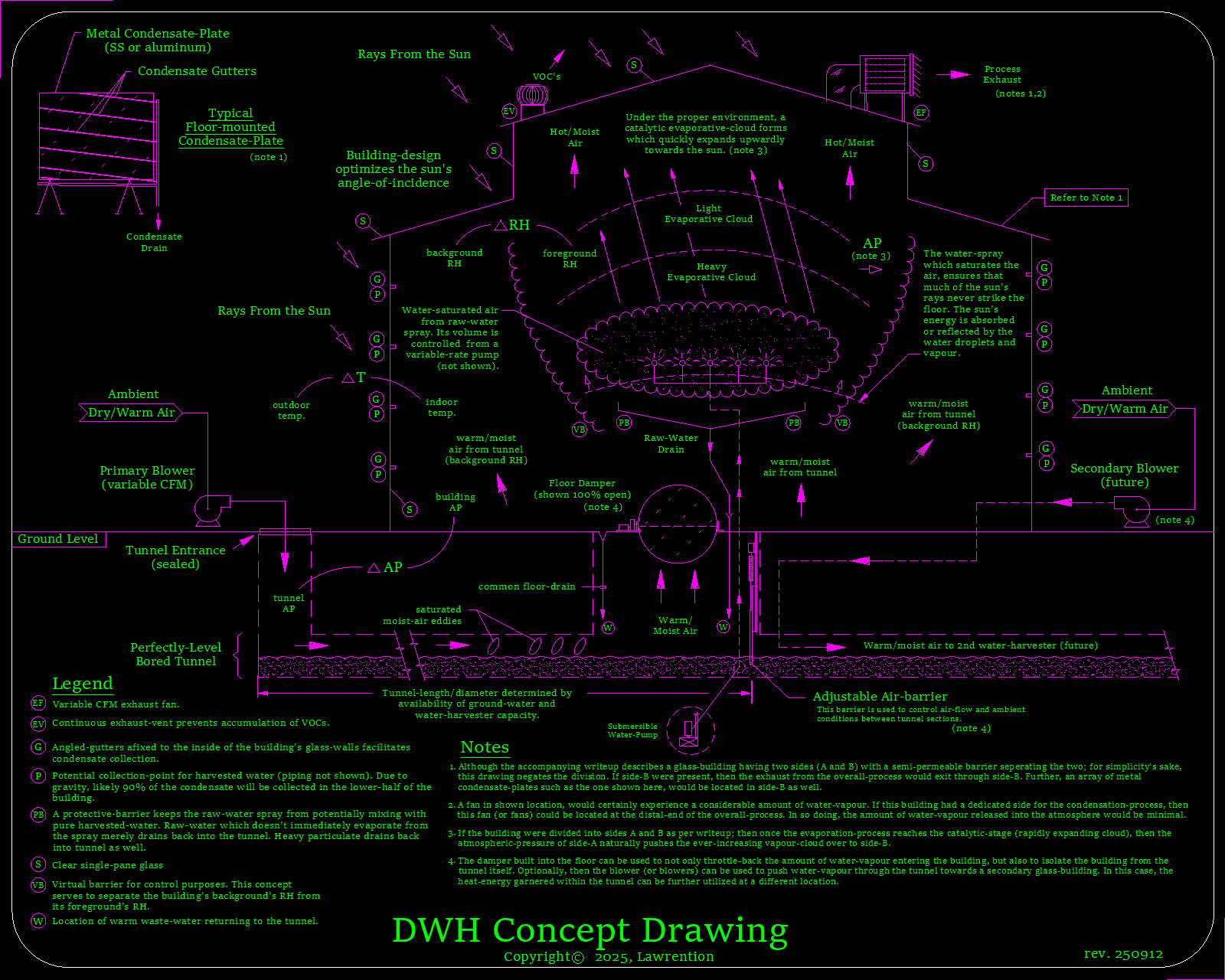
As a first step, this unique system requires a totally-level tunnel bored to a depth that taps into the local water-table. Once the underground-water saturates the tunnel’s length... the DWH takes advantage of this reservoir's enormous surface-area for natural evaporation. A dynamic air-flow through the tunnel, is the primary-means for extracting and delivering water-vapour. Under the appropriate conditions, this water-vapour subsequently produces pure-water condensate.
The main focus of this project, hinges upon the fact that pure drinking-water can be efficiently harvested by controlling the environment of two natural processes: EVAPORATION and CONDENSATION. In so doing, the moisture extracted from the air should be totally clean regardless of probable contaminants within the original ground-water. Although typically, observing water while it evaporates and later condenses is like watching paint dry, this Desert Water Harvester will be much more dynamic.
One of the great advantages of this Desert Water Harvester, is the fact that it can be used in areas where shallow wells are no longer feasible due to contaminated ground-water. Hence, it can be used alongside farmland(s) which create harmful runoffs from chemical-fertilizers, manure, and the like.
Furthermore, since ground-water can naturally seep into a horizontal-tunnel which covers a fairly-large geographical area… spotty water-production from vertical wells may be avoided. Obviously, a ground-water assessment would have to be completed before installing a tunnel-based water-harvester, and one which is somewhat vertically-challenged (depth-wise) when compared to conventional wells.
Since this Desert Water Harvester can be installed alongside farmlands, it can be used as a source for their livestock’s drinking-water. For interest’s sake, a single-head of cattle requires approximately twenty US-gallons of water per day. Due to human activities such as showers, toilets, laundry and such; humans require at least two or three times as much potable-water than cattle. This is a ball-park estimate.
Notably, it’s easier to estimate a cattle’s daily-consumption of water than that of a human, since human water-consumption varies depending upon one’s culture and cost-of-supply.
Setting aside a proper amount of real-estate, a Desert Water Harvester could also easily supplement a city’s water-supply. Perhaps an ideal-location for one of these systems is alongside a sprawling suburban housing-development. Theoretically, one of these water-harvesters could produce perfectly pure-water even if it was installed alongside a waste-water treatment-facility.
Energy-wise, this Desert Water Harvester will ideally be 100% powered by the sun’s rays. It’s realistic to assume that a mature DWH could deliver drinking-water at its full-capacity, even if there were a power-outage upon the local-grid. Notably, the DWH is quite efficient because it's not chemically creating H2O, but merely purifying water through a series of physical-state transitions. While so doing, its molecular contaminants remain behind.
The following items are what I perceive to be the Desert Water Harvester's primary components. The last-two items on the list are add-ons to the basic-system.
- FIRSTLY, a completely-level bored-tunnel of sufficient length and diameter is required to extract seeping water from the local water-table. Other than nuclear-waste perhaps, the initial quality of the water is virtually insignificant.
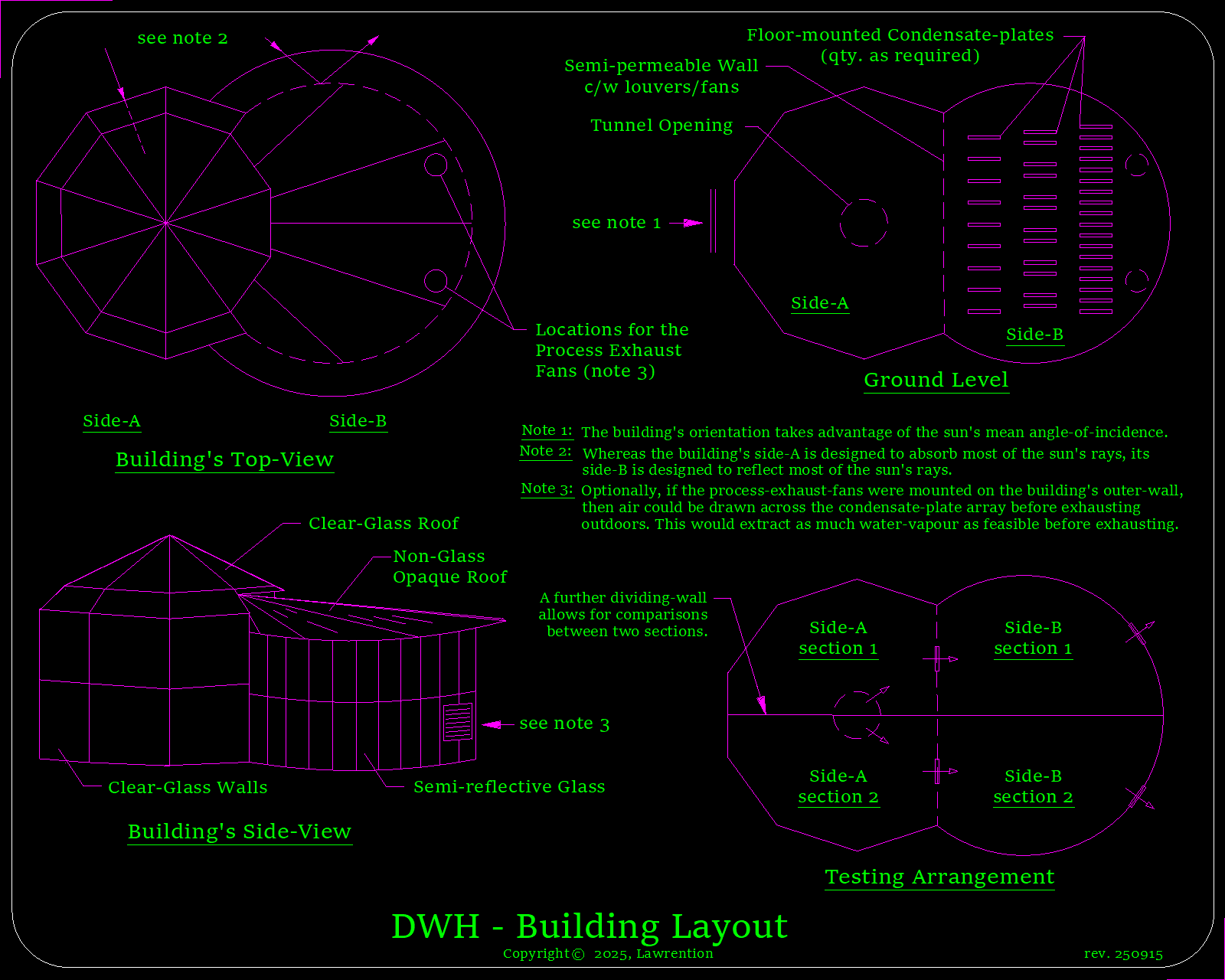
- SECONDLY, a large glass-building which harnesses energy from the sun, is erected directly over the tunnel. The connection between the tunnel and the building is simply a vertical-shaft. Diameter wise, this shaft’s opening is comparable to that of the tunnel. Whereas the glass-building contains the bulk of the water-harvesting equipment and might be compared to an oversized greenhouse - its functions and features are vastly different. In addition to the sun being harnessed by photovoltaics to electrify the DWH; the sun’s rays provide energy for the evaporation-process, various air-currents, and differential temperatures.
- OPTIONALLY, a gravity-fed water-distribution system can be added to the initial DWH. This water-distribution-system utilizes a rather large water-tower in addition to pumps and instrumentation which fill and monitor the tower. If properly engineered, I believe that any undue chemicals added to the drinking-water (such as chlorine) will depend more upon the design of the water-distribution-system than the DWH itself.
- POTENTIALLY, a bio-dome could be added to the DWH for growing crops and vegetables. Due to the cooling-effect of green-plants in addition to having these same plants produce gobs of oxygen from CO2 - a thriving bio-dome benefits the water-harvester itself. Although plants absorb water from the ground, they also release moisture back into the air (transpire). Further, plants not only absorb CO2, but atmospheric-toxins as well. I wasn’t aware of this previously, but certain plants are known for absorbing VOCs like benzene and formaldehyde. Unfortunately, due to potential infestation of bugs and bacteria, the bio-dome would likely have to be segregated from most parts of the DWH. At the moment, we can only ponder the implications of such an installation.
At this early-stage, I’m envisioning this Desert Water Harvester project as an EXPERIMENTAL PILOT-PLANT. The flexibility of its base-system allows for easy expansion and a generous-array of options. Basically, this document outlines how I perceive to be a practical-path forward, and certainly doesn’t take into account factors of which I am likely totally ignorant of. Further, there are no right or wrong answers at this point in time, it’s just that some approaches will be more efficient and/or practical than others.
As far as this project’s topology goes, differing physical-arrangements between a potential second-tunnel and likewise further glass-buildings are perfectly acceptable.
Although each installation (site) requires a single perfectly-level tunnel, adding additional tunnels and connecting tunnels of varying depths is quite doable. In fact, I’m sure that at certain sites, having a combination of tunnels with varying-depths would likely be the preferred topology.
For visualization purposes, the following two drawings explain the gist of the system.
Safety Concerns for the
Desert Water Harvester
I have been reminded of the fact, that I didn’t provide much info earlier as it pertains to safety aspects of this Desert Water Harvester. As a result, this sub-section was added in May of 2026.
If the Desert Water Harvester merely extracted H2O from the ground and left the nasty chemicals behind, that would be great. Unfortunately, due to our present industrial-era of heavy chemical use, there are likely a number of chemicals within the local ground-water which need to be dealt with in a timely fashion. Particularly if H2O is pumped out from the ground and then sprayed directly into the air through a nozzle-assembly.
There’s a good chance that a dead-ended tunnel without a continuous flow of water, will merely become more and more polluted over time as harvested-water gets extracted. As H2O is continuously extracted from the tunnel, whatever contaminants remain behind will naturally become more and more concentrated. For this reason, the DWH should be designed upfront for the worst-case scenario. Chemical-hazards will certainly be forthcoming. One of the primary concerns here, is having an undue buildup of volatile organic compounds (VOCs).
VOCs easily escape into the atmosphere, so they can be quite concerning inside confined areas. Common items such as fuels, paints, varnishes, household products and building-materials, all typically contain VOCs. Some of the chemicals of concern here, include: acetone, benzene, formaldehyde, styrene, toluene and xylene.
V.O.C. Mitigation
(Volatile Organic Compounds)
Of course, exhaust-fans and a continual influx of fresh-air is always important. I will mention here, that there are special pumps designed to remove and capture vapours including VOCs, from piping-systems and their associated containers. These special pumps are commonly used for handling paints and solvents.
Inside the DWH’s building; as water and chemicals get sprayed through nozzles directly into the atmosphere - these special-pumps can mitigate a significant number of VOCs before they reach the spray-nozzles.
Electrical Spark and Shock Mitigation
Liquids which generate high VOCs, generally also have low electrical-conductivity. Whenever pumps work against these fluids (with low electrical-conductivity), they generate electrostatic voltages and stray currents. This creates a dangerous scenario within these pumps and associated piping-systems. Dangers can ensue from electrical-shocks or sparks from the piping-system at hand. Personnel can easily become shocked, or a spark can set off an explosion in the presence of flammable vapours. Non-conductive piping within these installations, merely increases the odds for a buildup of electrostatics.
In order to minimize these electrostatic hazards, grounding conductors are added to the piping-system in question. Even if air-pumps were used instead of electric ones, the concerns caused from electrostatic-charges remain.
Typically for these installations, decent-sized grounding conductors are installed across surfaces and clamped to the piping-system to virtually eliminate the hazard. Instead of grounding at merely one point here, a ground-conductor can be looped through the whole-system and then connected back to the ground at both ends of the cable/wire. This method ensures that if a connection ever loosens-off or if the ground-wire gets accidentally severed, the system as a whole remains grounded. Notably, there are special ground-connectors which allow for a large stranded-wire to loop through a piece of equipment without needing to being cut.
As an added measure, each piece of equipment should likely have a dedicated ground. This methodology ensures that if a piece of equipment ever needs to be replaced or serviced, the grounds for the remainder of the piping-system remain intact. This also ensures that the generated-electrostatics from a particular pump, remain local to the pump in question. Here, a loop of ground-wire connects all of the equipment directly associated with the pump. This dissipates the electrostatics which are generated from the pump at hand.
A lot of what I discussed here, is common-practice for installations within spray-painting booths. Depending upon the hazard at hand, it could be worthwhile to connect with someone who has experience in this area.
Monitoring for Hazardous Gases
Nowadays there are gas-detectors for most types of gases, including hydrocarbons and VOCs. As an added precaution, these detectors ensure that the environment is safe prior to entry. At the very-least, I suspect that the underground-tunnel directly beneath the DWH, will require at least one gas-sensor of some sort.
In addition, whenever there's a new-installation around potentially explosive gases or dusts, a serious-study by a qualified Engineer needs to occur before the electrical-installation can begin. Such a study, classifies the area or areas in question. This determines which regulations apply for the wiring at hand. At least that's the way it is here in Canada when dealing with hazardous areas.
The Glass Building
From what I gather thus far, the type of glass which this building will be comprised of, could be quite unique. Not to mention, buildings with glass-roof's have a uniqueness all to themselves.
In order to keep people safe, and particularly for the first such installation; perhaps a safety-net made of twisted-metal-cable could be installed above the areas where people are expected to work. Although this wouldn't totally eliminate the hazard from the glass, at least if a large piece of glass came loose or broke and fell down from above; the metal-net would take the brunt of the blow.
Insert Rev. 260505
Background-Data Concerning USA's Supply and Distribution of its Drinking-Water
The following data primarily concerns the U.S.A. It’s a preliminary gathering-of-facts in order to determine the lay-of-the-land in order to later hone in upon potential-sites for Desert-Water-Harvester installations.
Ongoing Capital Costs. The 30,000 Foot View.
The EPA's “7th Drinking Water Infrastructure Needs Survey and Assessment” (DWINSA) which was released in 2023, assesses the needs of each state’s aging infrastructure alongside their growing populations. Within this survey, the estimated water-distribution/transmission costs, greatly exceed the costs of water-treatment plants.
The paragraph below from Congress, summarizes the needs of the USA’s drinking-water infrastructure. The text was obtained in March of 2026 from the congress.gov website. Here is the associated link.
“Drinking Water Infrastructure Needs: Background and Issues for Congress”
“In 2023, EPA compiled data from states and estimated that, over the next 20 years, the investment needed for drinking water system infrastructure would cost $648.8 billion (2022 dollars). This latest estimate is roughly $51 billion (2022 dollars), or 7.62%, more than EPA's prior estimate, published in 2018. About 67% (i.e., $436.8 million billion in 2022 dollars) of the estimated needs are for projects to repair or rehabilitate water systems' transmission and distribution networks. The need for routine replacement and rehabilitation projects is not novel, as a report from more than 20 years ago stated that water systems were then entering "the replacement era.” “
State by state rankings listed below, are based upon infrastructure needs over a twenty-year span. Forecasts include that of water distribution/transmission, water-treatment, water-storage, and water-sourcing. This list shows the six-states which are expected to consume the most capital over a twenty-year span. Of course this list largely hinges upon each state’s populous.
- California $83.515 billion
- Texas $61.253 billion
- New York $35.148 billion
- Florida $26.750 billion
- Pennsylvania $24.301 billion
- Illinois $22.211 billion
In addition, I found an analyses on the American Society of Plumbing Engineers (ASPE) website. It is based upon a recent report from the American Water Works Association (AWWA).
This report paints more of an urgent-picture regarding the country’s drinking-water infrastructure then the prior. It estimates that it will require an investment of $2.1–$2.4 trillion over the next 25 years towards the water supply/distribution infrastructure. The associated link is here.
Prominent States Requiring Lead Service-Line Replacements
Based upon the 7th DWINSA Data, the states having the most projected number of lead-service-lines needing replacement are listed below. This list is based upon an update to the initial survey.
- Illinois
- Florida
- Ohio
- Pennsylvania
- New York
- New Jersey
Prominent States Having Nitrate-Runoff Concerns
Excessive runoffs from agricultural nitrates, can certainly impact the effectiveness of a water-treatment facility. There are numerous states affected here, the most prominent ones concerning this issue are shown below.
This list was generated from the following sources: EPA SDWIS (Safe Drinking Water Information System) violation trends, USGS (U.S. Geological Survey) groundwater reviews, EWG (Environmental Working Group) analyses and related studies up to the year 2025.
- Iowa
- California
- Texas
- Nebraska
- Kansas
- Ohio
- Illinois
- Indiana
Prominent States Having “Forever Chemical” Concerns
(PFAS: Per- and Polyfluoroalkyl Substances)
PFAS impacts the drinking water of virtually every state. PFAS contaminants can occur due to industrial manufacturing, landfills, wastewater treatment plants, bio-solids applied to farmland; and the use of aqueous film-forming foam (AFFF) at airports, military bases and firefighter-training facilities.
The following states consistently rank highest for PFAS issues based upon data from the: EPA (Environmental Protection Agency), UCMR (Unregulated Contaminant Monitoring Rule under the EPA), EWG (Environmental Working Group, a nonprofit) and the NRDC (Natural Resources Defense Council, a nonprofit).
- New Jersey
- Michigan
- New Hampshire
- California
- Massachusetts
- Pennsylvania
- Florida
- Texas
Factors Concerning Desert-Water-Harvester Installations
The Desert Water Harvester was named as such, since it would easily serve like an oasis within the desert. Advantageously, it can operate autonomously while being 100% powered via the sun’s rays. Further, the daily temperature-extremes of a desert-like environment, adds to the efficiency of a DWH. That being said, so long as there’s plenty of sun above, and water below, the DWH should be efficient in most any environment. So long as the tunnel never becomes totally-flooded that is.
The Desert Water Harvester's design is such, that air must always be allowed to flow through the tunnel in order for the evaporation-process to occur. Further, to maximize the water’s surface-area during its operation, the tunnel which is basically a round hollow-tube, should ideally be half-full of water throughout its length.
Installations Alongside Man-made Dams
In order for a Desert Water Harvester installation to succeed, there first has to be a predictable-water-table within the ground. In most cases, a comprehensive ground-water study would be required long before the boring of a tunnel was ever initiated. Perhaps the best chance of success here, is to install the DWH's tunnel alongside a stable-waterway which already supports a predictably-stable water-table. For land-locked installations using rivers and/or lakes, a man-made dam should serve the purpose quite nicely. There should be a predictable water-table surrounding the reservoir upstream of the dam.
Dams have the ability to maintain a particular depth of water within their reservoir. If a dam has been there for any length of time, then there’s already a history of its success, due to its reservoir's seasonally observed water-levels. Hence, local to the dam itself, there will be a stable water-table within the earth just beside the reservoir. The amount of water which regularly goes over the dam serves as a good indicator for just how much water can be regularly extracted from the grounds water-table.
Analyzing this scenario further, if the dam’s reservoir periodically rises and falls due to seasonal variations, then perhaps the existing water-table can be virtually ignored altogether. To incorporate this adjustment, the DWH’s tunnel could be fed from the dam’s reservoir from a deeper-level. If the water to the tunnel was sourced just beneath the reservoirs seasonal low-point - then there should always be plenty of water at the source, regardless of the reservoir’s varying water-level. In this manner, the DWH’s tunnel could also serve as a sluice-gate for the dam itself.
If the downstream exit of the tunnel was blocked up to its midpoint, then the tunnel would always remain optimally half-full. Any undue water entering the perfectly-level tunnel, would merely exit the tunnel just downstream of the dam. In this scenario, an underground automated-valve would be inserted at the tunnel’s entrance just beneath the seasonal low-point of the water-reservoir. This would guarantee a continual supply of water for the tunnel regardless of time-of-year. A level-sensor within the tunnel, would automatically ensure that the tunnel's supply-valve keeps it optimally half-full.
Installations Near the Ocean
I believe that currently, the United States has over two-hundred operational desalination plants producing drinking-water. Most of these plants use either brackish groundwater or brackish surface-water as a means of supply. Generally speaking, desalination-plants having a brackish-water-supply are more efficient than those using direct seawater. Just a small percentage of these desalination-plants take saline-water directly from the ocean. California, Florida and Texas, are the states having the greatest number of desalination plants.
It seems that the most commonly used method for clean-water extraction within these desalination plants, is the reverse osmosis method (SWRO). Energy costs are approximately forty-percent of these plants operating expenses. Modern sea-water reverse-osmosis plants (SWRO) consume 2.4 – 4 kWh per cubic-meter in order to produce clean drinking-water. A certain percentage of this energy is spent while garnering supply-water prior to treatment.
The world record for the minimum amount of energy used by a desalination demonstration plant, is 1.794–1.86 kWh/m³. This was achieved in the year 2025 by a DESALRO 2.0® plant within the Canary Islands. This is a Guinness World Record for SWRO energy efficiency. Details of this achievement are described here, from Sciencedirect.com.
Often-times, the leftover brine from these desalination plants is carefully distributed back into the ocean. For land-locked installations, the waste from the brine is more difficult to contend with. As a dry by-product, sea-brine also contains minerals such as magnesium, lithium, potassium and calcium. Potentially, these minerals are recoverable.
Since the Desert Water Harvester is primarily powered by solar-energy, then it should be quite-advantageous energy-wise, when compared to a typical desalination-plant. Utilizing its tunnel for the means of extraction, water for the DWH can be obtained directly from ocean. In so doing, the rising-tide could easily fill a perfectly-level tunnel. When installed at the optimum level, perhaps there wouldn’t be any energy required to fill the tunnel.
Further, any overflow from the Desert Water Harvester that simply spills over its fixed-barrier which partially-blocks the tunnel’s exit (in order to keep the tunnel half-full), merely returns back to the ocean. Moreover, if deemed environmentally acceptable…. the tunnel’s contents could be periodically flushed back into the ocean to prevent an undue accumulation of byproducts. Importantly, there is no filter-like membrane to be concerned about, with the DWH.
Summary Concerning USA's Drinking-Water
From this brief survey, we see that there’s much to consider while narrowing-the-field in order to locate the most optimal sites for Desert Water Harvesters. Besides the DWH itself, the associated water-distribution system has to be taken into full account as well.
As I stated early on, a gravity-fed water-distribution system could easily be incorporated with a DWH. Whereas the sun shines for only certain hours throughout the day, a gravity-fed water distribution system, could efficiently operate 24-7.
Quite typically, remote areas have smaller populations, so drinking-water costs per capita are higher than that of a large city. Assuming that these DWH's are totally autonomous, they could serve as a single-source supply for clean drinking-water in remote-areas. What currently comes to mind here, are potential installations for the Native American and Tribal communities. For such cases, each DWH could likely be maintained by their respective community. Moreover, safety-wise; it’s much safer and less-complex to have a single-source supply for a potential electrical-grid.
The following, is a partial list for off-grid water-treatment solutions that are now being developed, or are already being utilized by Native American and Tribal communities.
- Arizona, New Mexico and Utah. Navajo Nation: Solar-powered desalination, nano-filtration and reverse osmosis plants which are designed to treat brackish or contaminated groundwater. From what I understand, the communities of focus often have no electricity nor running-water.
- Arizona, Hopi Tribe: Solar-powered Hopi Arsenic Mitigation Project (HAMP).
- Oklahoma. Choctaw Nation: Choctaw Defense Manufacturing have developed portable Reverse Osmosis Water Purification Units (ROWPU) under a partnership with ELW Global.
- Oregon. Confederated Tribes of Warm Springs: Here, “SOURCE Hydropanels” are utilized. These solar-powered atmospheric water-generators create drinking-water from humid air.
As another area of focus, perhaps at-scale DWH projects could be readily developed alongside waterway-projects which are already in the works. There are a number of considerably-sized projects associated with dams and reservoirs which are currently in progress, or shortly will be in progress. A few such examples are listed below.
- California, Sites Reservoir project near Maxwell in Colusa County. Construction is planned to start in 2027. Overall projected costs are very-approximately 6.5 billion*.
- California, Shasta Dam Enlargement. Located on the Sacramento River north of Redding. Projected final costs are very-approximately 3 billion*.
- Colorado, the Northern Integrated Supply Project (NISP). This project includes the Glade Reservoir located northwest of Fort Collins, and Galeton Reservoir located northeast of Greeley. Major construction to begin in 2027. Estimates for completion-costs have risen to 2.7 billion*.
- Colorado, the Gross Reservoir Expansion/Dam Raise in Boulder County near Denver. Full completion targeted for 2027. Final costs to be very approximately above 800 million*.
Notably, there are thousands of aging dams within the USA that require ongoing attention. The existence of these dams themselves in particular areas, emphasize the need for crucial water-reserves.
* Each one of these projects is quite unique, so it's hard to compare apples to apples. The numbers shown here are quite dynamic and will certainly change over time. Since these water-based projects typically increase reservoir-capacity and likewise the amount of acreage that becomes covered with water, existing landscapes change dramatically. Hence, the estimated-amounts shown, may well be used to prepare existing landscapes as well as for moving roads and such.
Unrealized Potential of the Desert-Water-Harvester
As near as I can determine, using a totally-level tunnel combined with a huge glass-building for harvesting pure-water is quite unique. I don’t believe that we will truly understand its full potential until one is built to scale. As a crude first-approximation design-wise, there will be a certain relationship or ratio, between the surface-area of the water within the tunnel, and the surface-area of the glass-building which is exposed to the elements.
Different from many distillation-processes, the supply-water of the Desert Water Harvester is not boiled in order to change state. The DWH-process is more akin to what commonly occurs in nature. In the outdoors, surface-water evaporates off of streams, lakes, and seas; then raises towards the sun in the form of vapour. This vapor condenses and then accumulates into a cloud formation. Depending upon ambient temperature, this H2O later returns to earth in the form of either rain, hail, or snow.
Undisturbed surface-water evaporates much faster within a dry environment than one with high RH and/or saturated with moisture. Hence, the quicker that water-vapour is removed from across the surface of a body-of-water, the faster the evaporation process becomes. This is where the dynamics of the DWH gets rather interesting.
When we boil water to create steam, the whole pot of boiling water has to reach a critical temperature (100° C) before releasing its vapour as steam. In addition, it takes a certain amount of energy to not only initially create the steam, but also to ensure that the steam remains in a quite-energetic state.
In contrast to the previous scenario, the Desert Water Harvester merely focuses upon the surface-water within the tunnel while converting liquid-H2O to vapour. Assuming that the water within the tunnel is relatively still, it’s the surface-tension of the water that the air reacts with. This is where the bulk of the vapour gets created within the tunnel. It's also why the dynamics of the underground-tunnel are quite advantageous.
The intent of the tunnel, is to always have a certain amount of air-flow from one end to the other across the water’s surface. Cool-dry air absorbs moisture much easier than warm-air, which tends to have a higher relative-humidity (RH). So, as cool-air flows across the water’s surface, it naturally picks up moisture and creates additional vapour. The faster the air-velocity through the tunnel, the greater rate of vapour-production. This rapid flow-of-air, ensures that as soon as vapour gets created - it’s instantly swept away. This ensures that the RH along the surface of the water remains relatively low, and the rate of vapour-production continues to remain relatively high.
A a natural consequence of the aforementioned process, this creates evaporative-cooling within the tunnel’s ambient air. As further vapour is introduced into the air-stream, mobile water-molecules absorb a certain amount of heat-energy. In turn, this reduces the average air-temperature within the tunnel.
As a consequence of this whole process, it's many-times more efficient to create water-vapour using air-velocity through a tunnel, than it is to boil water on an open stove-stop. Nonetheless, you might well ask : “but doesn’t it take a lot of energy to move the air across the water’s surface?”
I believe that the greatest percentage of electrical-energy required for the DWH-process, will be for the blowers which have to move air from one area to the next. Here, in order to minimize electrical power-usage and optimize the system - a certain amount of experimentation will be required.
As a crucial point; within the tunnel itself it’s much more efficient to move dry-air at a certain velocity, than it is to move comparatively moist-air. Hence, we don’t want to create a high ambient RH before it’s required. A high RH (saturated air) will not be required until the air-mass reaches the dedicated-area for producing pure-water condensate. Most-likely, the condensate-collection-process will occur above ground within the glass-building. A good portion of this condensate will collect upon the glass-walls due to a contrast of temperatures, between the inside and outside of the glass building. Any remaining viable condensate, can be collected upon strategically-placed metal-plates inside the building.
By experimenting with temperatures and air-flows, I’m hoping that the energy required for blower-activities can be kept to a bare minimum. Even though the plan here, is to use solar-energy and photovoltaics as much as possible; once the system is properly-sized and tuned, then natural-convection will become more of a prominent-factor. So, the unique design of the glass-building itself, must conform to the system-wide concept of maximizing natural-convection.
Again, the available-options here for the tunneling-system and building arrangement are quite vast. Perhaps temperature variations between one tunnel and another, could actually pull air through the glass-building. Further, by having two-glass buildings connected via a long common-tunnel, the timing of the evaporative/condensation sequence within each building could be staggered. The goal of this staggering effect, would be to create enough of a variation between atmospheric-pressures, in order to drive air-flows through the length of the tunnel. Hence, the air-flow-direction within the tunnel could periodically flip the opposite way.
Perhaps the highest-purpose for this Desert Water Harvester, is to actually install one within a desert. Depending up location, the water-table beneath a desert’s surface can be relatively-shallow or virtually unreachable. Under true desert conditions, the DWH’s tunnel would have be considerably-longer than what would otherwise be deemed normal. In addition, in order to save costs; a considerably-deep horizontal tunnel would likely have a comparatively-smaller diameter here as well.
Whereas in prior-conversations, I was considering that the tunnel would normally be half-full of water for efficiency’s-sake, beneath extreme desert-like conditions - that likely wouldn’t be the case.
Beneath a desert which experiences extremely arid conditions, a horizontal tunnel may have to be located (bored) up to one kilometer below the surface to reach water. Now, I can’t imagine boring anything that deep would be practical. Hence, installing a tunnel within an extremely-arid desert would have to be quite strategic. That being said, since a DWH’s tunnel is horizontal instead of vertical like a standard well; then the chance of striking water would be much greater at a certain depth.
It’s likely that a Desert Water Harvester installation within an extremely arid desert, might only experience water during certain months of the year. So, the methodology for its operation could be slightly different than what we’ve discussed thus far.
Nonetheless, if a cool-spring was found beneath the ground, it may still supply water throughout the year. The good news efficiency-wise here, is that whatever water is discovered deep underground will be extremely cold. Hence, the air-flow-process of the DWH that transfers water-vapour through the tunnel should be quite efficient.
Intriguingly, perhaps an air-flow injected into the horizontal-tunnel’s entrance here, would be enough retrieve an adequate supply of water-vapour at its opposing end. For this to work, there would have to be an additional vertical-shaft located at the horizontal-tunnel's exit point. If this methodology worked, then there would be no need to incorporate an underground-pump nor priming system within the vertical-shaft.
Final Thoughts
This pretty-much exhausts my thoughts regarding this Desert Water Harvester for the time being. I believe that I’ve flushed out enough ideas, so that certain experts can take it from here. My background is deep within electrical, instrumentation, and controls; not thermodynamics. I suspect that anyone with a fair-bit of thermodynamics and building-design experience, will quickly garner a gut-feel upon how to proceed.
The Lord brought this idea to my attention in January of 2023, so I’m sure it will be a resounding success. Previously, I did some work for the DWH’s water-distribution system as well. Obviously, that information is not adequately explained herein.
The water-distribution-system which I had in mind, is based upon a solar-powered gravity-feed water system. It would be quite capable of delivering water for miles in any one direction without the need of an electrical-grid. Due to the gravity-feed concept, it should be capable of supplying water 24-7.
The wild-card for this whole system concerns a potential biodome. Interestingly, plants themselves remove certain impurities like volatiles out from ambient air. I believe that the potential drawback to this biodome, is the possibility of having harmful bacteria getting mixed into the system's drinking water. This could very-well occur, if animal feces or their byproducts were used as fertilizer for green-plants which are located within the same building that produces pure-water condensate.
As I was thinking about this issue today, perhaps this biodome should be located within a separate glass-building altogether. In this scenario, the DWH's processing equipment could be installed within one building, and the biodome within another. These two glass-buildings could then be separated from one other across a certain length of tunnel. Hence, a single-tunnel could then supply water-vapour to both buildings. The drawback here of course, is that only one of these buildings could then be faithfully used as a source for pure drinking-water.
Since much of the earth's surface is contaminated to a certain extent, and many of our underground-wells have now become tainted, we need to search for viable options. The Desert Water Harvester is an efficient and viable-option for pure-water recovery, since it purifies water as it raises it out from the earth.
Notably, we do not collect or sell personal information from casual visitors to our site. The only personal information that we might use herein, is what's voluntarily given to us as one populates a form.

Recent Articles


-
The Day of the Lord - urgent!
Oct 02, 26 11:50 AM
The Day of the Lord is imminent! -
A Strategic Investment Opportunity
Oct 01, 26 09:13 AM
A Strategic Investment Opportunity -
Viruses and mrna
Sep 15, 26 10:58 AM
Viruses and mRNA