— The Working Atom —
(a.k.a. Particle Physics)
(Published August 2026)
| 🇨🇦 | 🕆 | 🇨🇦 | 🕆 | 🇨🇦 | 🕆 | L🇨🇦 |
— The Working Atom —
Introduction
This document presents a personal interpretation of the remarkable and profound realm of particle physics. Wherever feasible, it aligns closely with the contemporary understanding of the field. The reader should note that while a substantial portion of ideas presented herein are grounded in established concepts from secular science, others are certainly not.
Footnotes:
- This document fills a few gaps which could not be adequately explained within the earlier Gravity over Mass Concept.
- Wherever a particle’s properties are described herein, the reader should note that precision is not always the primary focus. The Particle Data Group (PDG) continues to serve as the international authority for compiling experimental data.
- As a means of disclosure, note also that parts of this document were generated with Grok by xAI. By honing in on the command of the English language (or lack thereof), you can likely tell which portions were reworked by Grok and those that were 100% written by myself.
Fundamentally, this work is derived from a series of visions and dreams received from the Lord over the course of a number of years. It represents an abatement of these spiritual experiences, interwoven with extensive secular research.
As I read through the Bible, it doesn’t take long to realize that there’s a flip side to the known laws of physics that we don’t understand. Essentially, this realization sparked the beginnings of this document.
Fortunately, numerous scholars far more knowledgeable than I have laid much of the theoretical groundwork for certain ideas contained herein. I frequently discovered that notions I believed to be original had, in fact, been proposed in some form by theorists years earlier. Consequently, a significant proportion of the concepts presented here have already been theorized. My contribution lies primarily in reorganizing and integrating these ideas in a manner that more closely aligns with what I understand to be Universal Laws.
Particle Physics is an intriguing and dynamic domain, where fundamental questions may remain forever unanswered. Indeed, it often appears that the more we come to understand, the more we realize the extent of our ignorance.
From an outsider’s perspective, many explanations offered to us that stem from particle-physics experiments seem strikingly unfamiliar and counterintuitive. It sometimes seems like physicists resort to speculative constructs. Typically, however, I’ve found that the more I learn, the more I realize that concepts I first regarded as mere figments of imagination were, in fact, empirically supported — especially those concerning high-energy experiments, where truth is oftentimes stranger than fiction.
Why has God released this information now? Well for one, is the fact that science has progressed to the point where much of this can now be understood. Moreover, God has placed tools in our hands, so that we can better chart the course for not only humanity, but for all of his creation.
Importantly, there's a spiritual substratum beneath our Universe we cannot see. Physicists still claim that we can observe and understand only about five percent of our Universe.
In a nutshell, the particles of our "natural world" use various forms that serve the purpose of further organizing its underlying spiritual world. The natural realm and spiritual realm work side by side. This notion is not unfamiliar, as we all understand that one's body is much more than the sum of its parts.
By faith we understand that the universe was formed at God’s command, so that what is seen was not made out of what was visible. (Hebrews 11:3, NIV)
How This Document Is Organized
This document introduces many new terms and ideas. For the most part, I have organized it so that each topic builds on the one before it. As a result, information is layered: a topic may be introduced briefly at first, with more detail coming later.
Document Navigation
Each chapter begins with an index of its sections. Because some chapters are quite long, subsections were added to cover the material more effectively. If you cannot find a topic by browsing the chapters and sections, there is also an alphabetical index. This A-Z index usually points to the location where the topic is first introduced.
At the left of the document are thin and thick vertical lines that mark the current chapter: each thin line stands for one and the thick line for five. Counting these lines shows your location within the overall document.
This document grew far longer and deeper than I originally expected, so it has been split into two parts. The second part (still being edited) begins at Chapter six.
Chapters
- Basis for The Standard Model
- The Informational Realm: A New Frontier
- Introducing Sub-Subatomic Matter
- Journey to the Light Realm: Beyond Information
- Seedicles: A Bridge Between Realms
- The Steadfast Solar-Terrestrial Environment
- Our Universal God
- The Working Atom Model
A-Z Index
Alpha Omega matter (ΑΩm), atomic mass concept, electrons, electroweak force, hadron mean-lifetimes, Higgs VEV, inter-realm pulse (IRP), Light electromagnetic force (LEMF), LHC luminosity, mean-square charge radius, neutrons, particle decay, particle showers, physical size, pixelation concept, point-like versus composites, protons, quantum chromodynamics (QCD), seedicles, seedicles within the Standard Model.
List of Acronyms
The following list comprises acronyms used within this document. Please take note, those flagged with an asterisk are proprietary and foreign to the Standard Model.
- *ΑΩm: Alpha Omega matter
- AR: atomic realm
- *CALM: curious alcohol like matter
- CERN: European Organization for Nuclear Research
- ELM: earth-like matter
- EWSB: electroweak symmetry breaking
- *IRP: inter-realm pulse
- *LEMF: Light electromagnetic force
- LHC: large hadron collider
- *SEMF: strong (or Standard Model) electromagnetic force
- *SLLP: spiritual letter-like particle
- *LR: Light Realm
- QCD: quantum chromodynamics
- SM: the Standard Model of particle physics
- *SMR: Standard Model realm
- VEV: Higgs vacuum expectation value
Chapter One
Basis for The Standard Model
This chapter contains three short sections regarding the Standard Model (SM) of particle physics. Further aspects of the SM are introduced later in the document where pertinent.
- The Standard Model's Four Fundamental Forces
- Elementary Charge (e)
- Strategic Facts Concerning The Standard Model
1.1 The Standard Model's Four Fundamental Forces
Before we embark upon this journey, I would like to provide a little context concerning matter and energy. The particles we are familiar with from the Standard Model (SM) are governed by four fundamental forces. These forces are listed below from strongest to weakest.
- Strong Nuclear Force — The strong force (or strong interaction) binds quarks into hadrons. Quantum chromodynamics (QCD) that concerns quarks and gluons, basically defines this force. Its residual effect provides the attractive force between protons and neutrons that overcomes the electromagnetic repulsion between positively-charged protons, thereby binding them into atomic nuclei.
- Electromagnetic Force — The electromagnetic force acts between electrically charged particles, producing attraction between opposite charges and repulsion between like charges. It underlies electricity, magnetism, electric fields, magnetic fields, and chemical bonding.
- Weak Nuclear Force — Responsible for radioactive beta-decay (neutrons versus protons), crucial for the nuclear fusion process, functions at an extremely short range.
- Gravitational Force — The force of attraction between any two objects having mass. Curiously, although it's the weakest of these four fundamental forces — it has infinite range.
The force carriers (or gauge bosons) for these fundamental forces — comprise gluons for the strong nuclear force, photons for the electromagnetic force, W and Z bosons for the weak nuclear force, and the hypothetical graviton for the gravitational force.
As a prime example for force carriers: photons are described as force carriers (gauge bosons) for the electromagnetic force since they interact with all particles having a non-zero electric charge. This includes both integer and fractional charges.
The Standard Model describes the strong, weak, and electromagnetic forces extremely well and serves as the foundation for particle physics of modern-day science. However, the SM does not (yet) include gravity. The graviton, the theorized carrier of gravity — remains elusively hypothetical.
1.2 Elementary Charge (e)
The elementary charge (e) is a well known fundamental physical constant which sets the strength for electromagnetic interactions. It has an exact value of 1.602 176 634×10−19 coulombs. One coulomb (1 C) is the amount of electric charge transported by a current of one ampere in one second. So, this quantum of charge is extremely small.
Curiously, what this elementary charge means exactly from a physical-perspective — no one really knows.
1.3 Strategic Facts Concerning The Standard Model
This section highlights components in the Standard Model which support later in-depth discussion.
The Standard Model describes the fundamental forces; within it, electroweak theory gives a unified description of two of them: the electromagnetic force and the weak nuclear force. The electromagnetic force works at long ranges and the weak nuclear force works at extremely short ranges.
The electroweak theory supplies the mathematical framework that successfully predicted the existence and properties for W and Z bosons. This unified force is often referred to as the electroweak force or electroweak interaction.
At energies above the electroweak scale (~100 GeV, about 100 times the rest energy of a proton) the two forces (electromagnetic force/weak nuclear force) are indistinguishable and manifest as a single electroweak force.
The phenomenon of this unified force is a similitude for what's later described in chapter-four as we tackle the topic of spontaneous symmetry breaking.
Quantum field theory (QFT) constitutes the foundational theoretical framework for the Standard Model. Indeed, the SM is itself a quantum field theory. In the era preceding the development of QFT, non-relativistic quantum mechanics treated particles as fundamental, conserved entities that could neither be created nor destroyed.
As QFT matured during the middle decades of the twentieth century, particles were reinterpreted as quantized excitations of underlying quantum fields. This new paradigm naturally accommodates the creation and annihilation of particles and provides the theoretical basis for concepts such as virtual particles and, in appropriate contexts, quasiparticles.
When exploring physical particles at such tiny scales, such as virtual particles or quasiparticles — much of this document focuses on exactly that realm. At these minute scales, please be aware that we are essentially encroaching on the spiritual domain.
Chapter Two
The Informational Realm:
A New Frontier
In order to understand certain aspects of the working atom, we are about to delve deep into its underbelly. This journey goes well beyond a conventional understanding.
Please note, this is neither a complete nor polished description, it is merely an early assessment — particularly concerning the atom's physical arrangement. I am sure my thoughts and impressions will evolve over time.
Surprising as it may be to some, there are physical particles which are orders-of-magnitude smaller than those of the Standard Model. I characterize these as being sub-subatomic in nature. Oftentimes contemporary notions describe these particles as "fields". Examples of such are: electrical fields, magnetic fields, quantum field theory.
Basically, we are peering into a realm composed of particles having physical dimensions that are quite likely orders of magnitude smaller than the elusive neutrino. Conceptually, neutrinos reside on an imaginary border. They sit on a conceptual wall that divides particles having mass — from particles without mass.
Although historically sub-subatomic particles have certainly been theorized (e.g., preons, aether, luminous aether) — they have not yet been detected. Nonetheless, we are embarking on a journey which now incorporates sub-subatomic particles into the atom’s physical structure.
Whereas mass and energy remain the theme at atomic and subatomic scales — INFORMATION is the predominate theme at the sub-subatomic scale. Essentially, there is an informational realm beneath the Standard Model.
As a analogy for size: if the subatomic realm consisted of rocks the size of your fist — then the sub-subatomic informational realm would be like tiny grains of sand on the beach. Imagine here that each grain of sand represents a “bit” of information. Interestingly, it's been determined that even ordinary grains of sand are characteristically unique.
As an example of this immense difference in scale, consider that early computers were once so large — that they required an entire room to house a single machine.
As technology advanced through the second-half of the 20th century, computers became smaller and smaller. As processors and memory-chips shrank in size — computers not only became far more powerful, but also dramatically more efficient. The amount of energy required to process and store information today, is a mere pittance of what it once was.
Energy-wise, the scenario I just described is supported by the laws of physics. The smaller we go in scale — the more efficient it becomes to store, retrieve, and process information.
It seems uncanny however, that even though modern information-processing is orders of magnitude more efficient than it once was — we require vastly more total-power to run today’s massive data centers. This paradox highlights just how much information is now propagating through our terrestrial sphere.
Incredibly, Ireland has a significant concentration of data-centers extracting power from their grid. In the year 2024, these data centers soaked up roughly 22% of Ireland's metered electricity.
Chapter Three
Introducing Sub-Subatomic Matter
Chapter-three is divided as follows:
3.1 Introduction
Notably, there are different forms of sub-subatomic matter supporting our Universe. I can’t say for sure exactly what the basis of their structure is; all I can do at this point is compare the characteristics of sub-subatomic matter to those of familiar physical matter.
Personally, I consider the definition of "sub-subatomic particles" as those which are much too small to be detected during particle-physics experiments. Therefore, a particle with mass that so happens to be less than a neutrino's and remains undetected — is by default sub-subatomic. So, theoretically, if a sub-subatomic particle was later detected — it would no longer be classified as sub-subatomic.
Originally, I was considering that this sub-subatomic matter was very similar to atomic and subatomic matter, albeit orders of magnitude smaller. Perhaps this sub-subatomic matter has its own basic group of “chemical elements” and is analogous to Earth’s hydrogen, helium, carbon, and oxygen. Who knows? After all, Earth's 118 highly-structured chemical elements must have been based upon something.
Note, that I have been made well aware of the following types of sub-subatomic matter. Importantly, this list is not necessarily exhaustive.
- Alpha Omega matter (ΑΩm)
- Spiritual letter-like particles (SLLPs)
- Sub-subatomic Water
- Sub-subatomic earth-like matter (ELM)
- Curious alcohol-like matter (CALM)
These forms of matter are those that ubiquitously support the Standard Model and are therefore integral for our Universe.
As we continue, we will be discussing Alpha Omega matter, sub-subatomic water, and the earth-like matter. The remaining two forms of sub-subatomic matter (SLLPs, alcohol-like matter) will be discussed in due course.
3.2 Alpha Omega Matter (ΑΩm)
Understandably, certain concepts put forth here are quite mind boggling. As for myself, I have been wrestling with this for a number of years now and still don't comprehend most spiritual concepts. Nonetheless, I have found that by putting one's (e.g., God's) personality aside for a moment and then focus upon the secular topic-at-hand has most certainly helped.
At this early stage, just be aware that this unique form of matter ubiquitously exists. Within this document, I will be highlighting known instances where Alpha Omega Matter (ΑΩm) intersects with our observable world. For obvious reasons, deeper aspects of Alpha Omega matter have been reserved for chapter-seven.
Being contingent upon God, ΑΩm has been strategically placed within our Universe and is basically its supportive structure.
Most Universal matter continuously moves and is highly kinetic; even though certain scientific models in chemistry and physics may appear to be static. For example, light itself consistently travels at ~300,000 kilometres per second (in vacuum). You would think at some point this matter has to slow down, wouldn’t you?
A curious phenomenon is the fact that light can be dramatically slowed and even stopped, through a laser cooled Bose–Einstein condensate. Curiously, Alpha Omega matter performs a similar function.
Baseball Analogy
As an analogy, imagine that particles fly around like baseballs across the field. Here, baseball players focus their energy to either hit, throw, or catch baseballs. Although the goal is not to drop the ball, it does occasionally happen. Notably, particles can go askew as well.
Whenever a batter swings at a pitch, the ball might just glance off their bat instead of getting a direct hit. Assume in this case, that the back-catcher can't catch the ball, so it ends up hitting the backstop (mesh screen behind the back-catcher). Analogously, if this ball was a particle, then it's the Alpha Omega matter that serves as the backstop.
Concerning particle physics, there are a few characteristics of Alpha-Omega matter which I consider to be important.
I believe that ΑΩm attracts virtually all other Universal matter (or can) including light itself. For the most part, Alpha Omega matter moves within the midst of other forms of matter. While so doing however, it normally remains undetected.
Whereas light moves freely at a tremendous speed, ΑΩm remains relatively slow, is highly consistent, and forms aggregates with both itself and other forms of matter. So, although ΑΩm is sub-subatomic in size, via aggregation — it can form clusters much larger.
For all these reasons, I characterize Alpha Omega matter as having negative-mass. Now, this is not to say that ΑΩm contains no mass, it's merely in a form that we are unfamiliar with. Perhaps the best way to characterize this ΑΩm is to simply state that it's a "fabric of space".
3.3 Sub-Subatomic Water
Sub-subatomic water ubiquitously existed long before our Universe was created. Although this form of water is quite similar to the form that we are most familiar — being clear and self-ionizing — its granular size is obviously different. So, minimally, there are two distinct granular sizes of water. There's H2O, as well as the form that's magnitudes smaller.
An Atom's "Core"
|
While describing processes within the atom, I may use the less precise term “core” instead of nucleus. Here, “nucleus” retains its standard meaning: the atom's central cluster of protons and neutrons. In contrast, “core” refers to the nucleus plus a slightly larger spherical region surrounding it. Several important quantum effects occur in this near-nucleus region. By using the term core, I include these surrounding quantum processes. |
Sub-subatomic water plays a vital role inside the atom. Several of its key functions include:
- Cooling the Atom’s Core: The atom’s nucleus contains virtually all of its invariant mass (rest mass) and serves as the atom's primary source of energy. Consequently, this is also where most of the atom's heat is produced. So, sub-subatomic water prevents the atom's core from overheating.
- Dampening the Electron’s Charge: Since atomic heat predominately emanates from the nucleus, the atom's distal and larger regions are significantly cooler. Deeper within this document, this next fact becomes more obvious: Importantly, sub-subatomic water tends to condense around the atom’s nucleus. Sub-subatomic water neutralizes (or dampens) an electron’s charge as it approaches the atom's core. The electron does not need to be fully immersed in water for this dampening effect to occur. Its environment simply needs to be humid-like to dissipate its electrical charge.
- Creating an Electrical Barrier: Quite typically, electricity travels longer distances through cold dry air, than it does through hot humid air. This is evident during winter months when our homes are especially dry. We can easily experience a shock due to static electricity after walking across a plush living-room carpet and then touching a metal doorknob. The sub-subatomic water assures that certain regions within the atom remain relatively free from static-electricity's undue effects.
Atomic Mass Concept
|
Heat-energy and atomic mass. Commonly, water stores latent heat energy as it changes state. Merely by understanding that there's a substantial amount of sub-subatomic water inside the atom, becomes a significant wild-card concerning its perceived mass. Whenever a molecular-structure begins to move, the invariant mass within its atomic cluster — migrates through a sea of sub-subatomic moisture. Due to this abrupt movement (distance-wise from an atom's perspective is dramatic), the amount of water and likewise latent heat energy within each atom can quickly change. In thinking this through, there's the realization that this sub-subatomic water could impact how we understand well-entrenched concepts like momentum and kinetics. Here, it is not just the invariant mass of atoms we are concerned with, but the mass of their aqueous environment as well. |
3.4 Sub-Subatomic Earth-Like Matter (ELM)
Similar to sub-subatomic water, I believe that there's also a sub-subatomic earth-like matter (ELM) that existed before our Universe was ever created. From what I understand, whereas primordial water was in relatively large supply, primordial ELM was not.
The only thing that I can compare this ELM to, is what we normally consider as top-soil and dust upon the earth. So, from a granular standpoint — it's form is magnitudes finer than what we would typically consider to be top-soil and dust.
Whereas I initially considered this primordial form of matter to be uniform in structure, similar to how we understand chemistry — I now don't believe that's necessarily the case.
Due to the vacuum of space, primordially — unless matter was shielded and somehow isolated from this vacuum, it was continuously being eroded into finer and finer forms of matter over an unfathomable length of "time". Hence, what tended to remain, was disparate variations of loosely-packed matter.
Moreover, this ELM is also comprised of undue waste products from the SM. Hence, Universal ELM is a consequence of two different sources — the primordial source, and the SM source.
Please note, I now understand that there are sub-subatomic metal-like forms of matter as well. So, please include sub-subatomic metals under the umbrella of ELM.
A Practical Use for ELM
Further along in this document, we see that protons and neutrons are indeed spherical in form which is often how they are (or where) depicted. Particularly, during the 1930's to mid 20th century, when physicists often considered protons and neutrons to be spheres having finite size.
The study of sphere packing helps to determine why certain proton-neutron arrangements seem to be more efficient than others. Particularly while considering the amount of wasted-space within the overall arrangement. Certain nuclei arrangements are more stable than others, merely due to the number of physical connections between spheres, and where exactly these physical connections are within the overall arrangement.
For a simple experiment, take a few golf-balls and arrange them into various patterns that likely match those of stable isotopes. It doesn't take long to realize why some arrangements instantly become more stable than others.
Concerning sub-subatomic earth-like matter (ELM) — one of its functions is to fill in crucial gaps within nuclei. ELM can be packed around protons and neutrons similar to how top-soil and sand gets packed around rocks and such. ELM serves to physically stabilize atoms, particularly those of high complexity. Moreover, since chemical nuclei commonly attract ELM, this action serves to keep empty space exactly that; empty.
Hard sphere-packing approximations remain useful in certain nuclear-physics calculations even today. Astonishingly, the physical aspect of nuclear physics descents to scales which is quite mind-bending. From what I understand, the atom's nucleus contends with both sub-subatomic water and ELM.
Chapter Four
Journey to the Light Realm:
Beyond Information
This chapter-four is divided into the following sections:
4.1 Introduction to the Light Realm
Intriguingly, as certain forces become weaker while descending to smaller and smaller scales — the Informational Realm becomes exponentially more powerful. Characteristics of this informational realm include the following:
- Granular-wise, the informational realm exists at the sub-subatomic scale and is universally ubiquitous. It consists of both electromagnetic energy and mass at a delicate and subtle level.
- This realm is a substratum of information and intelligence that is based upon light.
- If we envision particles of the Standard Model like ships on the water, then the informational realm would be the sea that keeps them afloat.
Importantly, this primordial substrate of matter has both physical and spiritual connotations. This matter is what was dynamically released when God declared "Let There Be Light". Our whole Universe is built upon this primordial substratum.
Personally, the term Informational Realm just doesn't cut it any longer, as I now consider our all-loving Creator. For this reason, I would now like to describe this primordial realm as either Light realm, realm of Light, or simply the LR.
As a spiritual concept, please consider that the acronym "LR" also represents God's left and right hands and/or arms. I believe this concept flows extremely well with biblical principles.
Now that we have incorporated God's Creation into this examination of matter, we see that there are essentially three distinct realms to our Universe:
- Light Realm (LR)
- Subatomic Realm (as physicists understand particles through the Standard Model)
- Atomic Realm (chemical, molecular, physical structures)
So essentially, the underbelly to our highly-structured Universe is the Light Realm. This realm's particles are sub-subatomic in scale, informational, and spiritual.
Essentially, the middle layer is the subatomic realm. This was built from the primordial substratum of Light (LR) and comprises the Standard Model's particle zoo. Since this subatomic realm revolves around the SM, let's simply refer to it as the Standard Model Realm or SMR for short.
Finally, we reach the larger-grained Atomic Realm (AR). This is our familiar world that we all experience with our God-given senses. It granular size comprises the familiar chemical elements and molecules.
To reiterate, the list below shows these three realms and the order by which they were created.
- Light Realm — LR, sub-subatomic in scale.
- Standard Model realm — SMR, subatomic in scale.
- Atomic Realm — AR, atomic in scale.
Although these three realms are characteristically unique, they remain quite cohesive since they support each other.
As we continue along this journey of discovery, since we are typically discussing particles invisible to the naked eye — envisioning our Universe through three different lenses becomes a convenient and powerful tool.
Since the substratum of our Universe is based upon light, let us discuss light for a moment.
Importantly, the light we see is actually a concentrated version of its former self. Photons which are granular subatomic in nature — are particles which utilize the much finer sub-subatomic particles of the LR.
Essentially, subatomic photons gather up sub-subatomic particles that seemingly travel arbitrarily through "fields" (within the LR) and convert them into energetic projectiles. A series of these energetic projectiles can simply be described as a "ray of light".
From this stance, photons serve as a means for focusing and redirecting light. So, photons themselves are not particles-of-light — but represent a quanta of light. Light consists of particles which are magnitudes-of-scale smaller than photons.
In order to garner perception of scale here, it's understood that it takes a consecutive number of photons approaching the eye from a certain location, before our brain responds and we sense the light's colour.
A couple of years ago, I came to the realization that the Light Realm as a whole is a certain form of intelligence. Notably, all things came through Christ who is God's only son (John 1:3, Colossians 1: 15-17). Christ himself is part of the Light Realm.
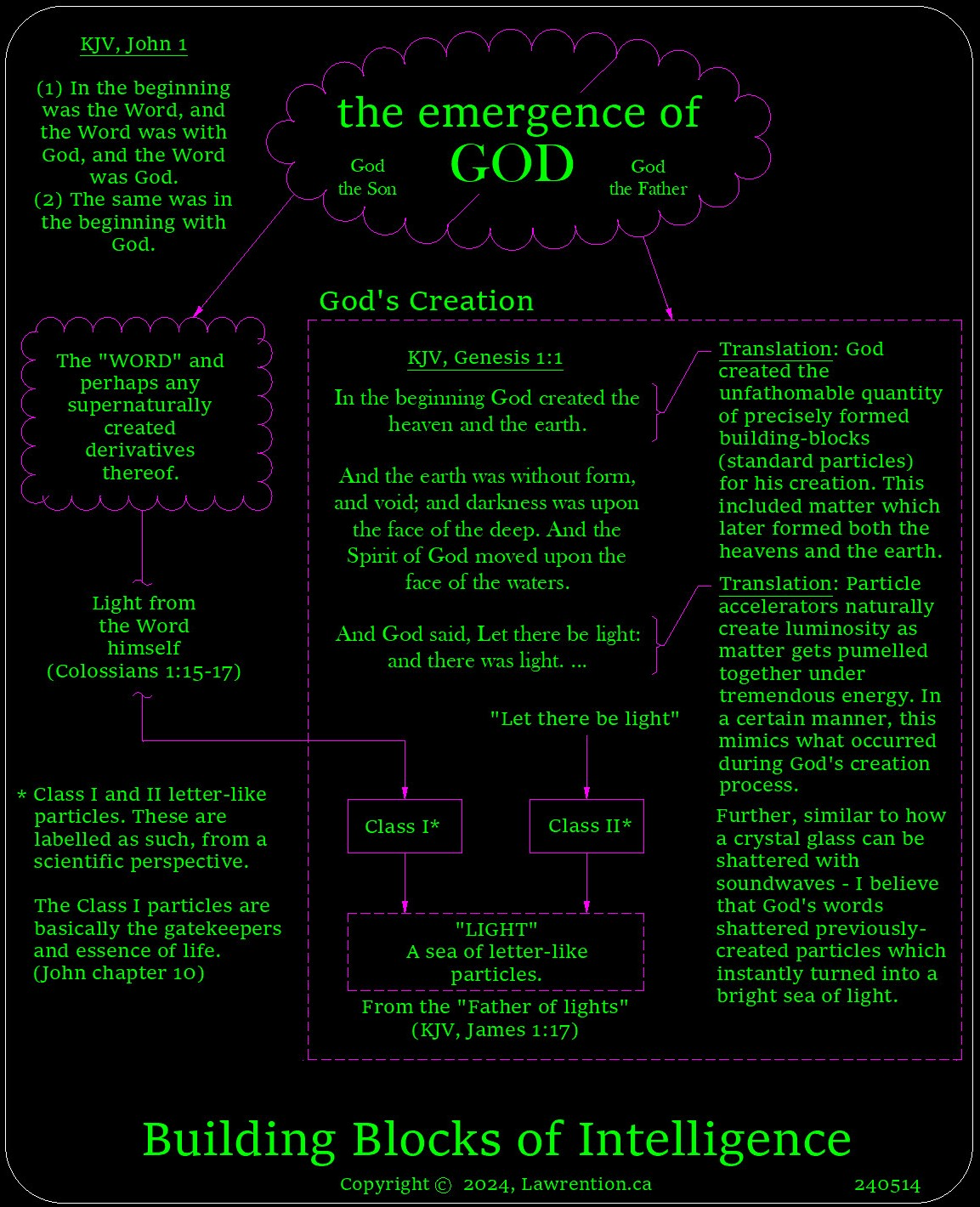
Understandably, spiritual concepts like this are quite mind-boggling. As for myself, I have been wrestling with this for years and still don't fully comprehend. Nonetheless... I have found that by putting one's (e.g., God's) personality aside for a moment and merely focusing upon the secular topic-at-hand has most certainly helped.
In a similar manner, although we understand our body is merely comprised of particles — it also, is so much more than the sum of its parts.
4.2 The LR's Primary Particle and Force
As we descend to smaller and smaller scales, certain forces naturally become weaker. Although the Standard Model's electromagnetic force is commonly demonstrated through phenomena such as molecular bonds and ionic interactions — there is also a comparatively subdued force within atoms.
Light Realm's Electromagnetic Force (LEMF)
|
As we descend to smaller and smaller scales, certain forces naturally become weaker. In particular, the Light realm's electromagnetic force. This force is orders-of-magnitude weaker than the electromagnetic force of the Standard Model. This subdued force is amplified through particles of the Standard Model. As a naming convention, perhaps we can refer to this lesser force as the Light electromagnetic force, or simply: LEMF. |
In order for atoms to quickly and efficiently shuttle information, their information medium must be extremely fluid. This is where sub-subatomic particles comprised of “hardened memory” come into play. Essentially, these are individual light particles.
I believe these sub-subatomic particles used for storing and retrieving data — are extremely dense, hard, and clearly electromagnetic. They likely experienced a tempering process when they were formed. Natural processes which create tempered glass and steel now come to mind.
The hardness of these sub-subatomic particles ensures that they can withstand intense kinetic pounding. A certain robustness is needed to withstand highly dynamic field-like effects. These particles of Light are essentially the atom’s lifeblood and also comprise electromagnetic fields.
In previous documents, I have referred to these unique particles of Light as Spiritual Letter-Like particles (SLLPs). Crucially, they have both spiritual and physical connotations.
As depicted in the earlier graphic, SLLPs are divided into two classes: Class-I and Class-II. The difference between the two classes is basically a means for separating spiritual and secular concepts. For the time being, let's refer to all of these primordial particles as simply SLLPs and forego the differentiation between classes. This allows us to focus on secular concepts that our minds might digest far easier than concepts of a spiritual nature.
Characteristics of Spiritual Letter-Like Particles (SLLPs)
Contemplating properties of matter at such fine scales is quite a mystery. I believe that SLLPs have both magnetic and electrical properties. Although anything having such a fine scale would most-likely be considered to be massless from a humanistic point of view, these particles actually contain mass.
- Each SLLP has an electrical property like a conductor.
- They can be charged-up like a capacitor, so each SLLP has the ability to carry a quanta of charge.
- Size for size, these structures are quite dense so have significant mass.
- SLLPs also have a structure and grain which allows them to be magnetized.
- Form-wise, each can be shaped slightly different. So they can also serve like letters of an alphabet.
Similar to the SM's elementary charge, each of these particles normally exhibit an electrical charge. Their quanta-of-charge however, is magnitudes smaller than the SM's elementary charge. Perhaps we can consider this to be a primordial charge.
I fully realize that all of this sounds quite obscure, I know. However, these ideas are quite logical after determining how SLLPs fit into the overall-scheme of things.
Generally speaking, on a grand scale — the forces and phenomena we've come to understand scientifically are merely manifestations from that which was here primordially.
Investigating SLLPs a little deeper, I believe that they are also paramagnetic. Paramagnetic particles can be easily magnetized, but temporarily — not permanently.
These SLLPs prefer to self-organize into chain like structures when feasible. Conceptually, this is comparable to how tiny magnets easily become serially linked together and can then be manipulated like the links of a chain.
Progressively, these bit-like particles can also coagulate into more permanent and layered composites. Analogous to what occurs in computers — these composite structures now function like words of data.
Physical Size
|
When it comes to determining a particle's physical size, it is the empirical size of the proton which serves as the measuring-stick. Protons have a known charge radius of ~0.84 × 10⁻¹⁵ metres (~0.840 femtometres). Although particles are often visualized as having a somewhat fuzzy envelope, I understand that protons indeed have a harden exterior shell. The last time I attempted to calculate the scale for SLLPs, I concluded that each of them was ~5 × 10-17 metres in diameter. I now believe it's possible however, that these particles could be even smaller. In theory, nothing need be smaller than the Planck length to explain our contemporary Universe. This idea was first proposed by German physicist Max Planck in 1899. The Planck length is ~1.616 × 10⁻³⁵ metres long. So size-wise, SLLPs are certainly well within the range of probability. |
To recap, SLLPs have been characterized as follows.
- These particles encompass both spiritual and physical connotations.
- They are bit-like, but also form "words" of data when utilized as composites.
- SLLPs are sub-subatomic in size and considerably smaller than neutrinos. They are equal to or less than: 5 × 10-17 metres in diameter.
- SLLPs are dynamically fluid-like and robust. They comprise electromagnetic fields and are essentially an atom's lifeblood.
- Physically hard and tempered. Certain physical-concepts apply, even at such a minute scale (e.g., how glass and steel become tempered).
- SLLPs are naturally paramagnetic.
- SLLPs also contain a primordial charge.
Although these particles are paramagnetic by nature, through the established concept of Curie temperature — I am confident that whenever they encounter extreme heat, they are also susceptible to a spontaneously structure change.
Furthermore, I believe neutrinos are actually SLLP composites. So basically, each neutrino is a nugget-like form of memory.
Reviewing Certain Terms:
- Standard Model (SM). Comprises the familiar subatomic particles which are governed by fundamental forces.
- Light ream (LR). This realm consists of sub-subatomic water, sub-subatomic SLLPs and the Light electromagnetic force (LEF). Without it, conciousness as we understand it would simply not exist. Spiritually, the LR is also an acronym for God's left and right arms throughout the Universe.
- Sub-subatomic water. Self ionizing, clear, and magnitudes smaller than molecular H2O. This water is a substantial part of an atom's infrastructure.
- Sub-subatomic earth-like matter (ELM). This matter comprises both primordial matter and waste products from the SM. Commonly, it collects in crevices within the atom's nucleus.
- Spiritual letter-like particles (SLLPs). Each particle is basically a "bit" of information. SLLPs play pivotal roles in our Universe's structure, its mass, the information-medium, and its inherent intelligence.
- Light electromagnetic force (LEMF). This is the small electromagnetic force which works through SLLPs at extremely short distances.
By merely accepting the fact that there is an underlying realm of matter that focuses upon information — it becomes much easier to explain experiments that often yield such obscure results.
For we are his workmanship, created in Christ Jesus unto good works, which God hath before ordained that we should walk in them. (Ephesians 2:10, KJV)
4.3 The Electroweak Interaction: A Contemporary Understanding of Mass
This section focuses upon mass-related concepts. In so doing, we begin to review some of the familiar SM particles. It is through the SM's electroweak force that creates W and Z bosons.
The electroweak theory unifies the weak nuclear force and the electromagnetic force into a single electroweak force at high energies. The electroweak theory is what mathematically predicts W and Z bosons.
At everyday energies, the unified electroweak force splits into the more familiar electromagnetic force that works long-range (comparatively speaking) and the weak nuclear force that works over short-range. It's conventionally understood that the weak nuclear force acts over distances much smaller than a proton’s diameter.
For reference, the particles listed below are the force carriers for the weak nuclear force.
Particle |
Elementary
|
Mean Mass |
Spin |
|
W+ boson |
+1 |
~80.4 GeV/c2 |
1 |
|
W- boson |
-1 |
~80.4 GeV/c2 |
1 |
|
Z boson |
0 |
~91.2 GeV/c2 |
1 |
These particles are point-like elementary structures having significant mass, and obtain their mass by interacting with the Higgs field. They are vector bosons which are copiously produced at the LHC. Their production occurs primarily through intermediate processes involving gluons and quarks, rather than from initial hadron collisions.
When these bosons decay, they produce either leptons (clean signatures) or quark-antiquark pairs. In the latter case, quarks rapidly hadronize into jets of hadrons. By the time these particles reach detector layers, the hadronization process is long complete.
Everything happens on an incredibly small scale:
- W and Z bosons are created through the unified electroweak-force and decay in roughly one trillionth of a trillionth of a second.
- The distance scale of their entire life is only about 10-18 meters (a billionth of a billionth of a meter). For comparison, a proton's charge-radius is on the scale of 10−15 metres.
- When a W boson decays into quarks, those quarks quickly turn into sprays of hadrons (called jets) within roughly 10-14 meters of the decay point.
- By the time these particles reach the first layers of the giant detectors which sit several centimeters away from the collision point — hadronization is already complete.
In other words, during both creation and decay of W and Z bosons — the dramatic action of the electroweak force — takes place over distances millions of times smaller than the diameter of a proton (roughly 10⁻¹⁸ meters). Yet, the byproducts of these events can be detected and studied with large detectors that are many metres across.
Historically, before the theoretical framework of the Higgs mechanism — gauge theories naturally predicted massless force carriers known as gauge bosons. This created one of the great mysteries in particle physics: how then could W and Z bosons of the weak nuclear force possess such large masses while still preserving the mathematical consistency (gauge invariance) of the theory?
The solution finally came from the concept of spontaneous symmetry breaking implemented through the Higgs field. Proposed in 1964 by three independent groups — Peter Higgs; François Englert and Robert Brout; and Gerald Guralnik, C. R. Hagen, and Tom Kibble — this mechanism elegantly resolved the problem.
The Higgs field is a scalar field that permeates all of space. Particles that interact with it acquire mass. The more strongly that particles couple to this field, the heavier they become. From a physical-perspective this interaction gives particles inertial mass, making them resist changes in velocity. This becomes similar to traversing through a certain medium. The particles that don't interact with the Higgs field such as photons, remain massless.
This realization was particularly important for experiments concerning W and Z bosons. Although gauge symmetry suggested these bosons should be massless — they are in fact quite heavy. In fact, they are more than 100 times the mass of a proton — yet remain point-like in nature with extremely short lifetimes (about ~3 × 10-25 seconds). The Higgs mechanism is what allows them to gain mass without breaking the underlying gauge symmetry of the theory.
In addition to the preceding statements, please note that the Higgs field also gives mass to fundamental fermions through Yukawa interactions.
The specific mechanism that gives W and Z bosons their mass is referred to as "electroweak symmetry breaking" (EWSB). Whereas spontaneous symmetry breaking is the general concept, EWSB primarily concerns W and Z bosons.
Although somewhat simplified, I believe the previous text explains the contemporary understanding of mass and the Higgs field. Nonetheless, the next section provides an optional means for describing the same phenomenon.
4.4 Inter-Realm Pulses: A Mechanism for Balancing Energy and Mass
Based upon the realization that there is a Light Realm (LR) — I would like to state that energy has the ability to quickly flow back and forth between realms. This mechanism serves to balance forces between the Standard Model realm (SMR) and the LR.
Essentially, energy can spontaneously flow between the subatomic and sub-subatomic realms. Here, transients can occur within an otherwise stable environment. I refer to each transient pulse of energy as an inter-realm pulse, or IRP for short.
I believe the spontaneous symmetry breaking that creates W and Z bosons is due to inter-realm pulses. Here, IRPs serve as a means for balancing mass and electrical charge between two different realms.
In order to explain the existence of W and Z bosons, I need to introduce a fundamental particle which was originally referred to as a "seed particle". Since that time, I have settled on the condensed term seedicle. Since these seedicles are fully characterized in later section-five, I will briefly describe them here.
Seedicles and the Electroweak Force
|
Seedicles have the uncanny ability to serve as tiny bridges between the Standard Model realm and the Light Realm. Importantly, I believe that seedicles are a similitude for the unified electroweak force that we had just discussed (section 4.3). Whereas the electroweak force describes a unification between the Standard Model's weak nuclear force and its electromagnetic force, I propose that seedicles bridge the gap between the SMR and the LR. Regardless of the terminology — it's always the unseen seedicles that remain the focal point during electroweak interactions as W and Z bosons are created. |
Analogously, seedicles move like a dramatic conductor who leads a large orchestra. Seedicles basically dictate what occurs in their immediate area.
Seedicles are almost ubiquitous by nature and lurch towards free mass when possible. As a direct consequence, they become the mysterious structure that has the ability to create particles on the fly.
In high-energy experiments such as those at CERN — it is common for seedicles to escape and "roam free" so-to-speak for relatively short periods of time. They can either remain in the background and be quite elusive, or manifest themselves in the foreground when SM particles are created.
Seedicles essentially serve as the focal point for W and Z bosons. If seedicles didn't exist, neither would these bosons. Notably, the number of seedicles close at-hand largely determines which particles rise to the occasion.
Concerning electroweak interactions, there are three choices for particles: W+, W-, and Z. These are vector bosons and carry masses of ~80.4 GeV for the W and ~91.2 GeV for the Z. For comparisons-sake, the Higgs boson has a substantially greater amount of mass: ~125 GeV.
In a nutshell, seedicles are point-like in nature and are crucial for the existence of W and Z bosons. The W and Z bosons serve to balance mass and elementary charge between the SMR and the LR. Since W and Z bosons are extremely short-lived, the seedicles which remain after their decay — can directly contribute to decay products.
Point-like Versus Composites
|
The following particles are generally understood to be elementary and point-like in nature. I believe that all of these particles rely upon seedicles for their existence in some form or fashion.
It's the seedicles within these elementary particles that enable them to bridge the gap between the SMR (Standard Model realm) and the LR (Light Realm). Elementary particles are point-like at tree level. Composite particles that interact electromagnetically generally have a measurable mean-square charge radius that describes how their charge is spread out. Composite particles include mesons and baryons. Although every meson and baryon has a mean-square charge radius — only a small subset have actually been measured. I would like to stress the fact that protons and neutrons are baryons, and pions and kaons are mesons. So these also, have a mean-square charge radius. This small group of particles is vitally important to how we experience the physical world. It seems we now have an easy way to classify Standard Model particles. Generally speaking, particles are classified as either point-like and fundamental or composite with a measurable spatial structure. Although this is a useful summary of the Standard Model, subtleties appear when one particle is compared with another, and those subtleties qualify the statement. |
4.5 Deeper Insights into the Light Realm
I understand that the Light Realm operates as a universal communications network. Buried within this network, is a certain amount of energy-pockets that serve as local buffers. It's these buffers of energy that tend to smooth out the concept of time itself. This phenomenon ensures the remarkable consistency of the Standard Model.
The LR supports the other two realms above it. So, it supports the Standard Model realm (SMR) as well as the atomic realm (AR). Essentially, SLLPs which arise from the LR are the lifeblood for our whole Universe.
In a round about way, this idea of having a Universal lifeblood is analogous to well-established concepts in physics. One such concept, is the weak nuclear force that operates at extremely-fine distances and is responsible for beta-decay and neutrino emission. Another ubiquitous concept, one which is perhaps the more profound — is the vacuum expectation value (VEV) of the Higgs field.
The Higgs vacuum expectation value (VEV) is the consistent background value that the Higgs field carries throughout the Universe. In natural units, its value is ~246 GeV. Theoretically, this value holds true even in completely empty space! The VEV is one of the most fundamental ideas in physics since it's responsible for giving mass to virtually all SM elementary particles.
Fascinating, is the fact that the Higgs VEV ties into the concept of the Big Bang. Once our Universe cooled and condensed into its present form (the electroweak phase transition) — it now sustains the known VEV of 246 GeV. It's understood that this VEV constant is required for elementary particles to have mass.
Although from a biblical-basis I don't agree with the full rational of the Big Bang itself, from a scientific standpoint — it most certainly has legs.
I thought it important to discuss the Higgs VEV here, as it shares intriguing parallels with the Light Realm.
Importantly, energy, mass, time, and gravity, are all supported by the Light Realm (LR).
One way to understand the relationship between the LR and the SMR is through the terms digital and analog. Here, the quantum-like atomic states behave as the digital layer — while the LR serves as its analog foundation.
Another way to understand the relationship between these two realms, is that the LR corrects course before things get too-far out of hand. Particularly while considering planetary motion and angular momentum. It becomes obvious that it takes less energy to correct course and nip an issue in the bud, than do so later. In other words: an ounce of prevention is worth a pound of cure.
A comparison between Two Electromagnetic forces
Please understand that our Universe has two electromagnetic forces to take into account. Of course, nothing has physically changed to add the concept for having a second electromagnetic force, only the terminology.
Currently, we have the Standard Model’s electromagnetic force as well as the Light Realm’s (LR's) electromagnetic force (LEMF). Although there could be exceptions of which I am currently unawares, as far as this document is concerned — the LR's electromagnetic force (LEMF) is now an analogy for the SM’s weak nuclear force. I realize that adding new terminology can certainly be confusing. However, by redefining a couple of terms here early in the process, it makes certain concepts which are on the near horizon — far more intuitive.
In order to differentiate between these two electromagnetic forces, let’s now use the acronym “SEMF” for the SM’s electromagnetic force. Here, the character “S” infers Standard Model. In so doing, we can now state that the stronger electromagnetic force is the SEMF and the weaker electromagnetic force is the LEMF. To recap:
- The weaker electromagnetic force (LEMF) is virtually identical to the Standard Model's "weak nuclear force".
- The stronger electromagnetic force (SEMF) is exactly the same as the Standard Model's "electromagnetic force".
I would like to stress the fact that these two new terms "Light electromagnetic force (LEMF)" and the "strong electromagnetic force (SEMF)" are tailor-made for this document and aren't acknowledged through the Standard Model.
According to Grok, the SM’s electromagnetic force is typically between 104 to 1013 times stronger than the weak nuclear force. Discrepancy in relationships between one force and the next, depend upon how comparisons are made. Regardless, at the very least — one (electromagnetic) force is 10,000 times stronger than the other.
Conventionally speaking, the electroweak force is the unified force which combines these two forces. However, we now realize that particle-wise — it’s the seedicle which essentially serves as the bridge and means for combining these two forces.
Chapter Five
Seedicles:
A Bridge Between Realms
Since most particles contain seedicles, there's a tremendous amount of information here on particles themselves. Currently, I believe the only particles which perhaps don't contain seedicles are neutrinos.
This chapter is subdivided into six sections:
5.1 Introducing Seedicles
As I revealed earlier, seedicles bridge the gap between the Standard Model realm (SMR) and the Light Realm (LR).
If you have ever heard physicists describe particles popping in and out of existence, well, that is exactly what's occurring! Simply speaking, seedicles attempt to garner enough mass until they qualify as a SM particle.
I am sure this next part is of no surprise to many, but form-wise — seedicles are comprised of string-like matter. Now, before your mind goes off into a bazillion and one directions (as the study of string theory is huge), please let me state the following: seedicles are discrete and uniform. Essentially, they are the most fundamental gauge-particle that concerns the Standard Model.
If these seedicles varied significantly in size from one to another, the Standard Model as we know it would not exist. In fact, if these seedicles were not gauge particles there would be neither uniform size nor mass at the atomic scale.
If you close your eyes for a moment and imagine a dandelion seed gently floating in the summer breeze, the image that comes to mind highly resembles a seedicle. At its most central-point is a hub that connects all of its strings. Each string is connected to the hub at one end and free at the other.
Electrical current garnered through the Light electromagnetic force (LEMF) travels from one string to another through the seedicle's hub.
The distal ends of this particle's strings commonly remain free, open, and flexible. Although seedicles have a natural spherical-shape when relaxed, they are often-times compressed into disk or saucer-like forms. This is basically what occurs as a dynamic electron gains both mass and momentum. When shaped like a Frisbee, electrons sail through space.
Since seedicles are composed of strings their morphology is virtually unlimited. Case in point (no pun intended), a seedicle can be rolled up into a point-like shape or stretch out into a relatively large sphere.
String-theory’s popularity stems from the fact that strings oscillate through various frequencies. This is why so many musical instruments use strings — the number of notes, chords, and scales they can achieve are enormous.
Importantly, each seedicle's string (or strand) is electrically conductive. A "current flow" through any single string tends to either straighten or buckle the string in question.
Seedicles never truly synchronize with fellow seedicles nor other forms of matter. They continuously wiggle about, are highly active, reactive, and very independent while non-confined.
Since seedicles operate through a plethora of frequencies, they are aptly-suited as intermediaries. They have the ability to rapidly climb up and down the electromagnetic-spectrum to suit their environment. They are quite robust and virtually indestructible.
Although I don't consider any particle to be actually massless from an absolute standpoint — seedicles have virtually no mass. This is why they cannot be detected directly. They basically serve as a massless background for the Standard Model's particle-zoo.
5.2 Using Quarks to Verify a Seedicle's Existence
As a group, the existence of seedicles is perhaps the primary factor that determines the consistency of the Standard Model. However, tracking these elusive particles is like a mystical shell-game. Honing in on particle decay, is perhaps the only way to actually track them.
I don't believe that seedicles actually "decay" . As I refer to particle decay, I am now speaking of the SM representation.
Particle Decay
|
As a layperson to particle physics, I found the term ‘particle decay’ something of a head-scratcher. Particularly, since this term does not imply that the final particle within the decay-chain is somehow less beneficial nature-wise than those that came before it. The following description from Wikipedia (2026) is certainly worth the read if you are unfamiliar. "In particle physics, particle decay is the spontaneous process of one unstable subatomic particle transforming into multiple other particles. The particles created in this process (the final state) must each be less massive than the original, although the total mass of the system must be conserved. A particle is unstable if there is at least one allowed final state that it can decay into. Unstable particles will often have multiple ways of decaying, each with its own associated probability. Decays are mediated by one or several fundamental forces. The particles in the final state may themselves be unstable and subject to further decay." |
Due to color confinement in quantum chromodynamics (QCD) bare quarks — despite being commonly theorized within the framework — have never been detected in isolation. Importantly, I would like to reveal the fact that bare quarks are actually seedicles.
Quarks are used to define baryons and mesons under the broader category "hadron". Bare quarks are envisioned to be point-like particles; whereas dressed quarks (constituent quarks), are those commonly described as having mass and interact at a relatively-larger scale. Since quarks are basically comprised of flexible dynamic strings (as seedicles), having two ideals for the same particle seems perfectly logical.
Quantum Chromodynamics (QCD)
|
The subject of quarks fall under the realm of quantum chromodynamics (QCD) which is the theory of the strong force. The colour aspect of QCD is merely metaphorical, although a very good one. Gluons are the force carriers of QCD. Quarks come in three color states: red, green, or blue. Each individual quark has exactly one of these colors. The strong interaction (mediated by gluons) changes the color of quarks while keeping the overall color-charge conserved. Isolated particles observed in nature are color-neutral. Importantly, hadrons are colour neutral, whereas quarks and gluons are not. Quarks and gluons are merely building blocks in this respect. |
Since our seedicle shell-game begins with quarks, and quarks remain highly confined within hadrons — let's familiarize ourselves with hadrons.
5.3 Hadrons Within the Standard Model
Hadrons are a major category in particle physics. Hadrons interact via the strong force and are subdivided into two primary groups: mesons and baryons.
Since we now understand that bare quarks are actually seedicles, we merely need to count the number of quarks within each particle to determine how many seedicles each contains. Fortunately, it's conventionally understood that mesons contain two quarks and baryons contain three. So, with mesons and baryons, it's basically that simple. The baryon in question has to contain either two or three seedicles.
Since seedicles are virtually massless, we need not be concerned about a particle's mass while tracking seedicles.
For the rest of this section I continue describing baryons for the readers who are unfamiliar. As one progresses through this document, the reasoning behind a particle’s lifetime and mass should become more intuitive.
Curiously, there are well over a hundred particles categorized as hadrons. As hadron resonances and antiparticles are included within the count — their numbers climb immensely!
As far as masses go, the proton is the lightest and most stable baryon. Where a baryon's mass can be upwards to six times that of a proton, a meson's mass ranges from very approximately one-tenth to ten-times that of a proton.
Distinguishing mesons from baryons largely relies upon spin, however — their quark content also determines one from the other. Notably, mesons contain two quarks (a quark-antiquark pair) and baryons contain three. So structural-wise, baryons are three-quark systems and mesons are quark-antiquark systems — both of whose dynamics and decays are dictated by gluon exchange in Quantum Chromodynamics (QCD).
Within a meson's quark-antiquark pair — each quark contains equal mass, in addition to equal but opposite charge.
Moreover, since mesons have full-integer spin — they are classified as bosons. In contrast, baryons comprise half-integer spin and are therefore classified as fermions. Fortunately, a comprehensive understanding of spin is not required for our subject matter at hand.
Particle Lifetimes and Stability
Generally speaking, the mean-lifetimes of mesons and baryons depend strongly on the fundamental force that mediates their decay.
Experimentally, typical lifetimes of particles follow a clear hierarchy based upon the mediating force. Examples of such are shown below.
- The strong force mediates the fastest decays, ranging from ~10⁻²0 to ~10⁻²4 seconds.
- The electromagnetic force mediates particles having decay times on the order of ~10⁻¹⁶ to 10⁻¹⁹ seconds.
- The weak nuclear force mediates the slowest decays, ranging from ~10⁻¹⁰ seconds to minutes. Curiously, the neutron is the only baryon with a lifetime measured in minutes. There is no other particle that experiences such a comparably slow decay.
- Protons are ultra stable and their decay has never been observed. They have a hypothetical mean-lifetime greater than 10³⁴ years.
While the mean lifetime of a particle offers a modest clue for distinguishing baryons from mesons, a far more significant point is that particles with the longest lifetimes are precisely those that make up the most familiar parts of our terrestrial world.
Note the exceptional stability of protons and neutrons compared to the remainder of their huge hadronic group. Interestingly kaons and pions, that have relatively-long lifetimes among unstable hadrons — play a key role in atmospheric cosmic-ray interactions.
|
Hadron Mean Lifetimes Meson Decay. All mesons are basically unstable particles. Regardless of this fact, it's the long-lived neutral kaon and the charged pions that experience the longest lifetimes within the meson family. Further, pions and kaons are by far the most common mesons — they are copiously produced via cosmic rays within the atmosphere.
Baryon Decay. Baryons comprise both stable and unstable particles and it's the protons and neutrons by far, which are commonly understood to be the most stable particles within the baryon family.
|
5.4 The Power and Consistency of Twos and Threes
As we determined through the mesons and baryons, twos and threes are pretty basic when it comes to particle interactions.
Obviously, an individual particle is much too small to be seen or touched by humans, so everything we understand about particles are basically models. For the most part, since we have determined that particles are actually physical constructs — we can delve deeper into potential particle-particle interactions. Here, we begin with the simple aspect of kinetics.
Two-particle Interaction: Kinetics
Let us begin with two particles of relatively equal mass and size; simply referred to as particle A and particle B.
If by chance, these two particles (A & B) happen to meet — they have one of two choices: they can either kinetically bounce off of one another and go their separate ways, or — they can unite (annihilate one another) and form a single unit. There is not a third option under this kinetically-based scenario.
In this scenario, if by chance A and B annihilate each other after a head-on collision — then a new particle is created. Let's simply refer to this new particle as "AB".
By strictly focusing upon kinetics, it's far more likely that A and B glance off of one another than incur a head-on collision and thereby form resultant particle AB. Moreover, if there is not enough kinetic energy available to begin with — then there won't be enough energy to form a new particle.
In this kinetically-based scenario, let us say that there's a five-percent chance that particles A and B annihilate one other in order to form particle AB. More often than naught however, particles A and B will glance off one another and merely go their separate ways.
Three-particle Interaction: Angular Momentum
We will now add a third particle to the previous scenario. Let us simply refer to this third particle as particle "C."
Under this scenario, particles A and B approach each other with the same kinetic energy as before and forcefully make contact. A recoil action ensues, so these two particles proceed to distance themselves from one other. This is where particle C enters the fray.
Here, particle C acts as an intermediary and limits the recoil effects of one or both of the original particles (A, B). While so doing, this gives time for electromagnetic forces to take affect between the group. So here, in this scenario — we are not only dealing with kinetics, but electromagnetic forces as well.
In effect, the intermediary (C) bides time for particles A and B during the recoil, that allows the weaker (distance-wise) electromagnetic force to take hold and initiate angular momentum. All three particles are ultimately affected due to intermediary C. Once angular momentum is established, it's much easier to create a new particle (ABC). After this three-particle process begins, it's the angular momentum that keeps the reaction going.
The intermediary particle initiates a dance between the three, whereby an oscillation is established between kinetic and electromagnetic forces. This oscillation equates to what we simply refer to as angular momentum.
With the earlier two-particle example, we estimated that there was just a five-percent chance of particles A and B annihilating each other and forming a new particle (AB). However, under the second example we see that the three-particle interaction immensely increases the odds for creating a new type of particle.
Moreover, the three-particle interaction doesn't have to occur instantaneously to create a new particle. Whereas the two-particle interaction strictly relied upon kinetics which is essentially over after one strike — the three-particle interaction relies upon angular momentum.
Once angular momentum is established — heat-energy is allowed to rise over a comparably longer period of time versus the strictly kinetic approach. After the three-particle system garners enough heat, they can now fuse together in order to create a new particle (ABC).
When we compare the potential dynamics between two-particle interactions (or system) versus three — it seems obvious why the highly-stable protons and neutrons are comprised of three quarks and not merely two.
Merely the existence of angular-momentum itself, can easily cause catalytic effects that support higher and further complex forms of matter. Hence, number three in itself is very common in particle physics. A few familiar examples are shown below.
- Colour charge within quantum chromodynamics is based upon the three primary colours: red, green and blue.
- Quarks have three generations: up/down, charm/strange, top/bottom.
- Leptons as well, have three generations: electron/electron neutrino, muon/muon neutrino, tauon/tauon neutrino.
For those you thinking that this is merely a coincidence, we find that this number three is highly fundamental in the science of biology as well. In biology however, instead of studying subatomic particles — it's molecules that remain the focus.
- Triplet nucleotide sequences (codons) in DNA encode specific amino acids.
- ATP is the common energy currency of the cell. Its energy is stored within a highly-efficient triphosphate group.
- Embryos contain three germ layers: the ectoderm, mesoderm and endoderm.
5.5 A Candid View of The Standard Model
Importantly, the thread which pulls this whole section together is the topic of seedicles. This section is further divided into the following sub-subsections:
5.5.1 Seedicles Within the Standard Model
The following list represents my current understanding (or best guess) as how these seedicles conform to the Standard Model. Since seedicles are merely just strings, they can be either fully-active, partially-active, or even non-active. The ones remaining non-active and dormant, would likely be coiled up into point-like structures and hidden within composites.
The number of seedicles shown in the following list, assumes no dormant seedicles. Therefore, this list represents the minimum seedicle requirement for each particle.
- Each electron and positron comprises one seedicle.
- Minimally, W and Z bosons each contain one seedicle.
- Muons comprise two.
- Each tauon comprises three.
- Regardless of wavelength, each photon contains three seedicles.
- Most mesons comprise two, but may also comprise either four or even six.
- Baryons comprise either three, six, or possibly even nine seedicles. Neutrons however (categorized as baryons) are another matter.
- Neutrons comprise four seedicles: three internal and one external.
- Minimally, each quark encompasses one seedicle.
Using nature as an example, the structures shown below are wind-dispersed seeds that are from either a dandelion or close relative. Their radiating filaments act like sails that easily get pushed along by the wind.


Form-wise, I believe that seedicles are very similar to what's depicted, however likely even simpler. Whereas these dandelion filaments can be soft as cloth, I suspect that seedicle filaments are comprised of something that's typically much harder. Perhaps seedicle filaments can be compared to electrically conductive spring-steel, where its properties are subject to change with extreme temperatures.
Importantly, as each seedicle collects SLLPs and gains sufficient mass — it quickly morphs itself from a seed into an actual "particle".
5.5.2 Electron (e)
Electrons are one of the simplest particles since they incorporate just one seedicle. Since seedicles contain virtually no mass, the electron's mass is obtained through the collection of numerous SLLPs. SLLPs are formed of densely packed matter so they contain a significant amount of mass, even though they have such a minute size.
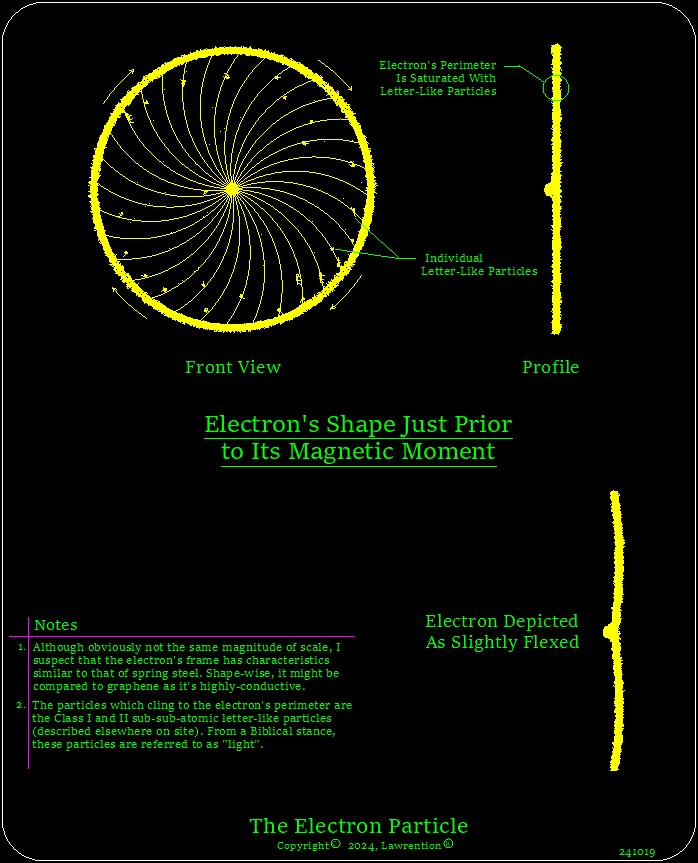
Depicted below, is a mock-up of a high-speed valence electron. Electrical-magnetic interactions (LEMF) between the electron's seedicle and its plethora of SLLPs — ensures a continuous ring-current about its perimeter.
The electron's spin snatches SLLPs from "empty" space. Once its rim is fully saturated, additional SLLPs that it encounters are merely sloughed off. This could be about the time that the electron experiences its "magnetic moment".
The image below represents part of a dynamic vision I received in April of 2019. The image to the left represents an electron and the one to the right represents a proton. The yellow border around the electron is its elementary charge.
I believe this vision was showing me what typically occurs during (elastic) electron–proton scattering experiments used to determine a proton's empirical charge-radius.
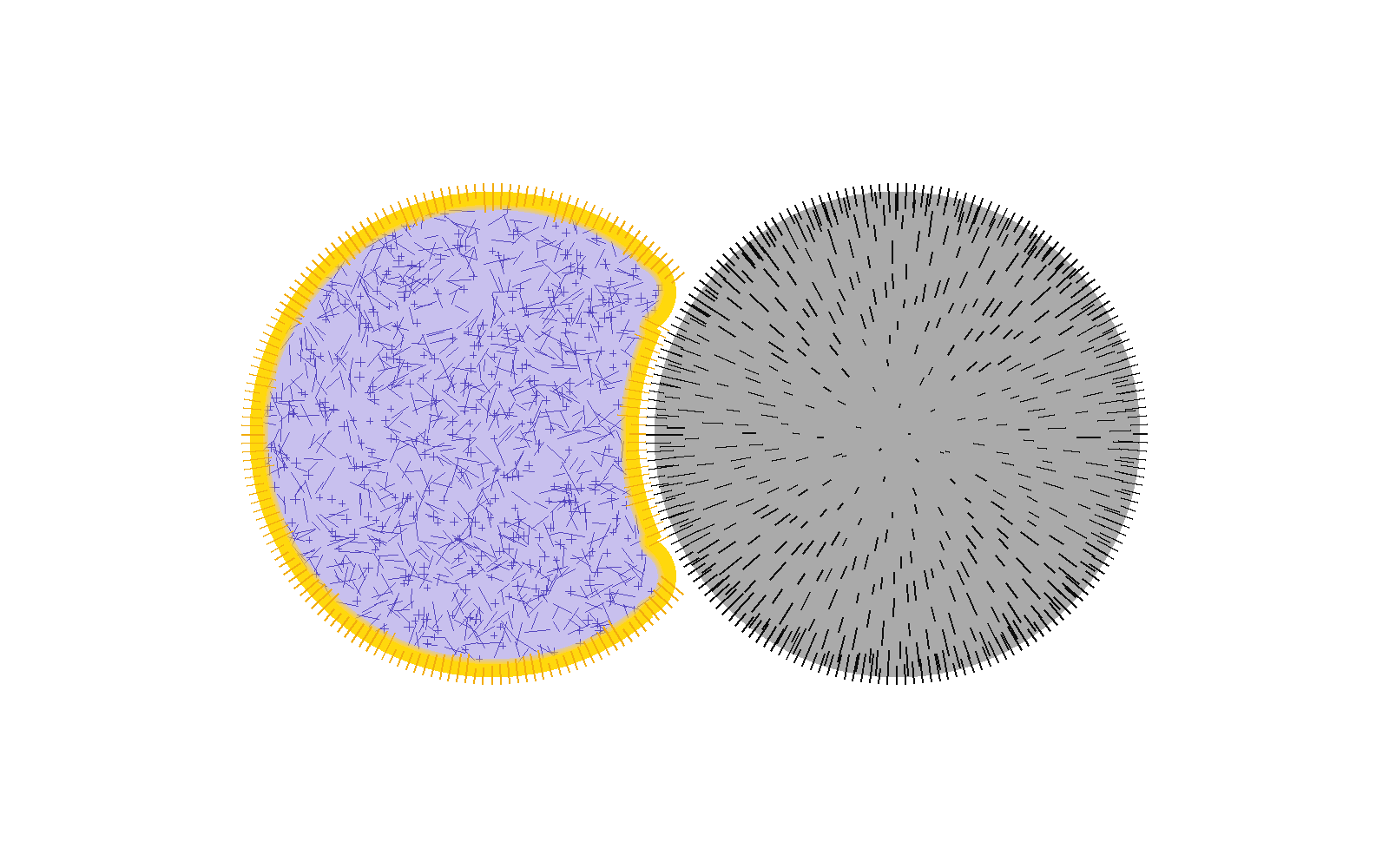 Electron - Proton
Since the string-like seedicle is the underlying structure for the electron, the electron can take on varying forms. Please note, the earlier drawing of the electron represented a high-speed valence electron and not one that would normally reach an atom’s nucleus. I do not believe that either of these two graphics adequately depicts an electron as it would normally appear while approaching an atom’s nucleus.
5.5.3 Proton (p)
Protons are commonly characterized as composite structures with two up quarks and one down quark — three quarks in total. From my understanding, protons are spherical in shape and have a hardened shell. Analogous perhaps to an egg that has a hard shell, albeit perfectly round.
Up quarks have an elementary charge of +2/3 e and down quarks have an elementary charge of -1/3 e. The net effect of two up-quarks and one down-quark validates the proton's known charge of +1 e.
In my mind, three quarks merely mean that the proton's core comprises three seedicles. I am fairly certain that if we could hold a proton in our hand and physically crack it open — we wouldn't be able to tell one quark from another.
After cracking a proton open and setting its textured shell aside, we would be left with three seedicles (stringed structures) and a little bit of curious alcohol-like matter (CALM).
Due to the earlier examples in section 5.4, we found that three-particle interactions are the simplest and easiest way to initiate and sustain angular-momentum. From this stance, it makes perfect sense that each proton contains exactly three quarks.
Since protons contain three-quarks, they essentially comprise three seedicles. There is a caveat however, and that is this.
There's always the possibility of a proton's core having more than three seedicles if there are one or more that remain inactive. From time to time —Individual seedicles can, and do — remain coiled up like point-like balls when not required. Since all seedicles are virtually massless, they have no effect towards the proton's functionality. So, when trapped inside a proton — a dormant seedicle should have no effect upon a proton's mass nor elementary charge.
As I stated earlier, protons have a hardened exterior and are essentially condensates. I understand from the Lord that under normal circumstances they have a physically-hard exterior. The powerful hadron colliders of today, can easily heat protons until they turn into a quark-gluon plasma (QGP).
The curious fluid inside each proton is analogous to alcohol, but on a sub-subatomic scale. Of course, alcohol withstands temperatures far colder than water without freezing.
Notably, alcohol has the potential to carry a static electrical charge. It's common for alcohol to build a static electrical charge from friction while flowing through pipes/pumps and such. With alcohol, a significant electrical charge also builds through processes like spraying, pouring, and agitation. So essentially, the proton's elementary charge is stored within this curious alcohol like matter (CALM).
5.5.4 Neutron (n)
Similar to the proton, each neutron has exactly three quarks. Their quarks comprise one up quark (+2/3 e) and two down quarks (-1/3 e). The net-effect of these three quarks, negates its elementary charge. Again, since the basis of quarks are seedicles — neutrons comprise three seedicles. This is the conventional understanding.
Regardless of the preceding statement, surprisingly — each neutron is basically a proton with one additional seedicle.
In order to negate a protons elementary charge, one seedicle wraps around its shell. This just occurs on the neutron's exposed area within the atom's nucleus. Since seedicles are primarily strings, they can easily wrap themselves around the proton like a glove. This phenomenon is what transforms a proton into a neutron. It's the extra seedicle that negates the proton's elementary charge and converts it into a neutron.
In other words, a seedicle has the uncanny ability to shield a proton from electrons, so that it can't interact with anything beyond the bounds of the atom's nucleus. As a result, it becomes classified as a neutron.
Please be aware, that the overall effect within an atom's nucleus is obviously more complicated that what I have just described, but basically — this is the phenomenon that creates neutrons.
A crucial concept here is the fact that seedicles are fundamentally gauge particles. So size-wise, there's an important relationship between seedicles and protons as one seedicle shields an individual proton from the atom's electrons.
The neutron is the only particle where its decay time is measured in minutes. During beta-minus decay — a NEUTRON within an unstable nucleus spontaneously decays into a proton, an electron, and an electron-antineutrino.
Similarly, during free neutron beta-decay — an isolated NEUTRON left to its own demise — decays into a proton, electron and an electron-antineutrino. This naturally occurs in just under fifteen-minutes.
Notably, an INVERSE PROCESS can occur here as well. During beta-plus decay (also referred to as positron emission) a PROTON within an atomic nucleus is transformed into a neutron by emitting a positron and an electron-neutrino.
These three examples of particle-decay — were all mediated by the weak nuclear force. From what I understand, whether a neutron is transformed into a proton, or a proton is transformed into a neutron — the quarks within the associated proton's core remain intact. What changes exactly, is the seedicle arrangement upon the nucleon's surface!
Since seedicles are virtually massless, a couple more or a couple less — does not significantly affect the atom's mass.
5.5.5 The Nature of Particles
This sub-section contains a few personal thoughts regarding particles in general.
At one time, I naively thought that tracking seedicles through well-defined decay processes (decay-widths and branching ratios) should be reasonably straightforward. I have found that unfortunately, it's not that simple. Nonetheless, seedicle tracking through particle-decay can be achieved in limited circumstances.
I believe that due to God's clever design, there is always an abundance of seedicles on earth which ensures predictable branching-ratios (BR) during particle decay. Hence, there's a chance that inherent to every SM particle (subatomic) there could be an extra seedicle that remains dormant or seldomly called upon. Analogously, this would be something like carrying one or more spare-tires within the trunk of your car.
In order to save space within modern vehicles, spare-tires are usually much smaller than their counterpart. This is not unlike compactified seedicles which can be coiled and point-like in form when optimized in order to save space.
Seedicle Pixelation Concept
|
My current impression is that seedicles pixelate earth's environment in order to provide both a substrate and path for future particles. This is somewhat analogous to the available pixels which populate a computer screen. Here, seedicles are used a background for varying colours (wavelength) and contrasts (size) in order to suit the occasion. However, seedicles themselves remain colourless and simply blend into the background. In contrast to the fixed-number of pixels built into your computer-screen, seedicle density is not fixed and can quickly change. Seedicles tend to congregate only where mass is present. If there is no mass to be had, then seedicles merrily continue along their journey. Hence, seedicle concentration per volume-of-space can vary substantially from one area to another. |
In some ways, particles are similar to people — they don't like to be either too hot or too cold. Although they are certainly attracted to one other, if there is too much heat within their environment, they tend to disperse rather quickly.
Consider that temperature is always measured as an average temperature. For example, if we consider one's core-body temperature — it is merely an average-temperature due to the trillions of cells that comprise our body. Here, each cell contributes a certain amount of heat towards the overall body temperature. The temperature that we can easily measure is an average-temperature of our body's trillions of cells.
Curiously, it has been determined that within individual cells, there can be a difference of perhaps two-degrees Celsius. If I recall correctly, I've run across articles that describe a cell's delta-temperature as considerably greater than merely two-degrees.
The point being, the smaller we go in magnitude-of-scale — the more likelihood it is that we will detect a variance of temperature. This concept holds true regardless of what we are measuring.
Particles themselves have the ability to both heat and cool. Since the atom's nucleus contains much of its invariant mass, this is also where most of its heat resides. Electrons traversing an atom's structure serve as a means for atomic convection.
This idea of particles not liking excessive-heat manifests itself in a variety of ways. I believe this concept is self-evident due to certain reactions in particle physics. The following interactions are prime examples.
- Thermal dileptons (lepton/antilepton pairs) which emerge from hot quark-gluon plasma.
- The obvious quark/antiquark reaction within mesons (resonance).
- Scattering that occurs between particles and antiparticles.
A substantial part of an atom's environment consists of the sub-subatomic water we discussed back in chapter-three. This minute form of water serves to disperse heat energy amongst molecules. Particle-wise, this ensures moderate temperatures, and likewise — stability.
For round numbers, I believe that there are approximately one-thousand SLLPs within each electron. Considering that there's merely one stringed seedicle per electron — that's a thousand-to-one ratio.
Continuing along this train of thought, consider the number of electrons within each atom typically matches its atomic number (Z). So, there's certainly a myriad of SLLPs within each atom if there's a thousand for each electron.
As a quick example, let's use the chemical element neon. Neon has the atomic number (Z) ten, so it has ten electrons and ten protons. Here, if each of its electrons comprise a thousand SLLPs, then each neon atom contains about ten-thousand SLLPs! We would be forever and a day, trying to determine what's actually going on with its individual SLLPs.
Basically, we have come full circle and have caught up to the scientific study of quantum mechanics. Seemingly, we are limited to using mathematical statistics to describe what's physically occurs within the atom.
Understandably at this extremely-fine scale, we are now peering into the spiritual realm. Crucially, as a matter of respect — please understand that this is God's "scientific" domain and not mankind's.
5.5.7 The Iconic Higgs Boson
This Higgs Boson section is subdivided as shown below.
- A Contemporary Understanding of the Higgs Boson
- Higgs Boson Production
- An Unconventional Understanding of the Higgs Boson
5.5.7 (1) A Contemporary Understanding of the Higgs Boson
A discussion of particle physics would not seem complete without discussing the Higgs boson. The Higgs boson is the observable quantum excitation (or ripple) of the Higgs field.
The Higgs field is a quantum field that fills space throughout the Universe. It has a vacuum expectation value (VEV) of ~246 GeV. This VEV is what spontaneously breaks the electroweak symmetry. (Recall, we briefly discussed the VEV in earlier section 4.5). The "Mexican-hat potential" which you may have run across — is the mathematical form for describing the potential energy of the Higgs field.
The discovery of the Higgs boson in the year 2012 confirmed that the Higgs field does in fact exist and behaves as predicted by the Standard Model.
Characteristically, the Higgs boson has no electric charge nor colour charge, but it does have a tremendous amount of mass: ~125 GeV/c2. Being quite unstable, the Higgs boson has a lifetime of merely ~3 × 10⁻²² seconds.
For comparison's sake, the five heaviest elementary particles of the SM are shown below. Note that the Higgs boson is second on the list. These particles are all point-like in nature, have a significant amount of mass, and obtain their masses by interacting with the Higgs field. They are abundantly produced at the LHC; primarily through intermediate processes that involve gluons and quarks rather than directly from hadrons.
The W, Z, Higgs, and top quark, are extremely short-lived; whereas the bottom quark forms hadrons (B mesons and baryons) which experience much longer lifetimes. This allows bottom quarks to travel detectable distances before finally decaying.
Particle |
Mass |
Mean Lifetime |
Spin |
|
Top Quark (fermion) |
~172.8 GeV/c2 |
~5 × 10⁻²⁵ seconds |
1/2 |
|
Higgs boson |
~125.1 GeV/c2 |
~1.6 × 10⁻²² seconds |
0 |
|
W boson |
~80.4 GeV/c2 |
~3.2 × 10⁻²⁵ seconds |
1 |
|
Z boson |
~91.2 GeV/c2 |
~2.6 × 10⁻²⁵ seconds |
1 |
|
Bottom Quark (fermion) |
~4.18 GeV/c2 |
~1.5 × 10⁻12 seconds |
1/2 |
— For comparison, the proton's mass is ~0.938 GeV/c². —
Listed below are the most common Higgs boson decay-channels:
- The most popular decay channel is through a pair of bottom quarks (b b̅ ). This occurs ~60% of the time.
- Two W bosons (W-W+)
- Two Z bosons (ZZ)
- Two photons (γ γ)
- Two tau leptons (τ−τ+)
Curiously, it's hard to believe that the Higgs boson is described as being point-like, yet has such an enormous amount of mass. I had always thought that the Higgs boson was something much larger.
Perhaps the most crucial aspect of the Higgs boson is the fact it's the only elementary particle in the Standard Model with zero spin. A spin-zero particle possesses no intrinsic angular momentum and is described through a scalar (or pseudo-scalar) field. Within quantum field theory, such particles are quantized excitations of scalar fields; commonly referred to as scalar particles.
5.5.7 (2) Higgs Boson Production
CERN’s Large Hadron Collider (LHC) presently constitutes the sole remaining operational hadron collider worldwide. It has recently entered a planned shutdown of approximately four years to facilitate substantial upgrades. The Relativistic Heavy Ion Collider (RHIC) at Brookhaven National Laboratory (BNL) in New York has been permanently decommissioned. Its facility is undergoing conversion into the Electron-Ion Collider (EIC) with full operations anticipated in the mid-2030s.Electron-positron colliders continue to operate in Japan, China, Italy, and Russia.
At CERN’s LHC, the primary means for producing Higgs bosons are through proton–proton (pp) collisions. The LHC accelerates two beams of protons in opposite directions around its 27-kilometre (underground) ring and collides them at specific interaction points. The ATLAS and CMS detectors are the main experiments that search for (and study) Higgs bosons at these interaction points.
Theoretically, with enough energy — electron-positron (e-e+) colliders can create Higgs bosons as well via the Higgsstrahlung process (e+e− → virtual Z → ZH).
At the Large Hadron Collider I believe there are five ways of producing Higgs bosons while colliding protons under high energies. Here, we merely review the two most common modes of production, since they produce ~94% of all Higgs bosons.
- Gluon Fusion (ggF). This is the dominant mode and produces ~87% of Higgs bosons.
- Vector Boson Fusion (VBF). This is the second most common mode and produces ~7% of Higgs bosons.
Gluon Fusion mode. Following a p-p collision, two gluons combine through a loop of virtual quarks. Essentially, this is a virtual top-quark loop. By utilizing a top + anti-top pair a quantum-like process produces a Higgs boson.
Vector Boson Fusion mode. After a p-p collision, two quarks emit either a virtual W or Z boson (one from each quark). Here, two vector bosons collide and fuse into a Higgs boson (a scalar). The original quarks scatter at high angles.
LHC Luminosity
|
"Luminosity" is one of those terms that cannot necessarily be taken at face value. Generally speaking luminosity means brightness or radiance. During experiments at the LHC however, it refers to something much more specific. Luminosity at CERN’s LHC is a measure of the potential frequency of hadron collisions normalized to unit surface area (cross-section) over a given period of time. It essentially describes the particle packing density inside the beams combined with how tightly those beams remain focused at the impact point. In other words, it's a means for describing the number of potential proton-proton collisions. It is not simply describing photon production or light emission. When running at its peak, the LHC produces up to approximately two billion proton-proton collisions per second at the center of the ATLAS and CMS detectors. The higher the collision-rate during production runs the higher the luminosity. Most of the light emission is invisible and within the regions of ultraviolet and soft X-rays. Importantly, the production runs that create "luminosity" — mimic much of what occurs within earth's upper atmosphere during particle showers. |
Earth's Particle Showers
|
Energy-wise, particle accelerators that collide hadrons have advanced to the stage where they mimic much of what occurs in Earth’s upper atmosphere. The highest-energy cosmic rays that enter Earth’s atmosphere often have energies on par with, or greater than, those produced at the LHC. These high-energy cosmic rays (protons and heavier atomic nuclei) collide with the nuclei of atmospheric gases (primarily nitrogen and oxygen) in the upper atmosphere. As a direct consequence, large numbers of pions and kaons (mesons) are produced. As these pions and kaons interact and further decay — they generate a cascade of particles (muons, electrons, neutrinos, etc.) that form extensive particle showers. Secondary particles from these showers are mainly muons that eventually reach Earth’s surface. |
The sequence of events during LHC proton-proton production runs are:
- The Initial State
- Hard Scattering
- Parton Shower and Hadronization
- Decays.
Higgs bosons emerge after the initial-state and are a result of the hard scattering process. During basic proton-proton collisions, quark gluon plasma (QGP) is generally not expected to form. QGP is produced during heavy-ion collisions, not p-p collisions.
During high-luminosity conditions — a typical bunch crossing contains ~1–1.5 × 10¹¹ protons. Out of each bunch that traverses the ring — only about 20 to 50 proton–proton inelastic collisions typically occur. This is a very small number considering the amount of protons which are racing around the ring.
5.5.7 (3) An Unconventional Understanding of the Higgs Boson
What I am about to describe here, is a unique interpretation of the processes that lead up to forming a Higgs boson.
Importantly, the Higgs boson is the only elementary particle that has zero spin. This essentially means, it has no intrinsic angular momentum and is therefore a scalar.
This next thought is certainly not precise, but I believe this zero-spin characteristic could be a unique way of describing an explosion. Particularly since explosions project outwards in all directions from a central point and exhibit zero angular-momentum. Although this was my initial thought as I scanned through visuals of the Higgs boson, I believe we can now go far deeper.
Gravity: I believe that gravity's effect is negligible in high speed particle experiments. Generally speaking, matter is oblivious to earth’s gravity until it advances to the stage of an atom. Atomic structures are influenced by gravity, whereas particles not bound by atoms are not; or certainly not to the same extent.
Gravity is basically a function and feature of quantum mechanics. I attempted to explain this earlier, within the "Gravity over Mass Concept". So, for the most part — gravity is a none-factor during Higgs boson production.
Environment: At the LHC, proton–proton hard scattering takes place in an ultra-high vacuum inside the beam pipe. The detectors sit just outside that vacuum around the beryllium pipe. Conditions in the pipe at the crossing are as follows:
- The residual gas is mostly H2, with H2O and other species present only in trace amounts.
- The beam vacuum is an ultra-high vacuum from which moisture has been removed. At the interaction point, the beam pipe is a thin beryllium tube so that low-Z particles can easily escape into the detector. The pressure here is about 10−9 to 10-10 millibar (10-7 to 10-8 pascals).
- Whereas the beryllium beam pipe (at the interaction point) is near room temperature — most of the ring is cooled to 1.9 K, with the beam screen at 5–20 K.
Since virtually all of the H2O has been removed from the vacuum, quite likely most of its sub-subatomic water has been removed here as well. In either case, it's a very dry environment and ideal for sustaining electromagnetic interactions.
Hard Scattering: Protons have a hard exterior, so “hard scattering” describes this process nicely. This hard scattering is analogous to the tremendous amount of energy it takes to shatter safety-glass.
Force: After the hadron collider’s initial state (proton-proton collisions) the Light electromagnetic force (LEMF) is what dominates over extremely short distances. The SM's electromagnetic force (SEMF) doesn’t arise until later in the process and over comparatively larger distances.
Type of Matter: The proton’s spherical shell is comprised of a neatly orientated and fused matrix of SLLPs. Its innards comprise three seedicles as well as a curious alcohol like matter (CALM) that's normally encapsulated. Its seedicles remain partially coiled within the CALM fluid.
Hard Scattering Process: During the hard-scattering process as protons experience direct strikes — they instantly burst open. After this event (which requires a certain threshold of energy) a plethora of SLLPs get released and instantly scatter. Consider how safety-glass normally shatters into large pieces as well as smaller shards and slivers. These shattered pieces, seedicles, and liquid CALM — comprise what's normally described as "partons". Conventionally, partons are understood to be quarks, anti-quarks, and gluons.
This is difficult to explain at this stage, but the proton's shell is more than merely a fused conglomerate of SLLPs. There is yet another form of matter that would normally ensure the proton remains intact, regardless of the process.
In a large part, this extra binding is what significantly slows-down certain physical processes, some of which are "particle decay". I believe this extra binding is what causes the phenomenon of "strangeness".
In either case, this extra binding is what keeps the proton's shell from simply shattering into a plethora of extremely small pieces. So, instead of its shell shattering into say approximately one-hundred pieces — it breaks into possibly three, four, or six clumps. Here, each clump represents a bundle of SLLPs that so happen to carry an electrical charge. Proceeding now, a series of processes will attempt to cobble together these severely-damaged hadrons.
SLLP Ring Creation: Powered by the Light electromagnetic force (LEMF), individual SLLPs lightly-interact with one another. As seedicles are released from each proton (due to their three-quark character) each seedicle potentially becomes a catalyst, which is dependent of course upon the availability of SLLPs.
As a catalyst, a stringed seedicle first interacts with a comparatively-small group of SLLPs. This action begins to amplify the LEMF. The process continues (which is virtually instantaneous from our standpoint) until a large ring of SLLPs form. Here, a single seedicle (the catalyst) now sits at the edge of the ring.
Once this seedicle has garnered a vast number of SLLPs and its ring has filled out — it becomes a fixed composite unit. In effect, a single seedicle alongside numerous SLLPs have been transformed into a ring-shaped object that’s now electrically on par with the SEMF. Here, an elementary charge is now presented by the ring itself. Basically, this ring has matured into a SM particle — or, at the very least — a virtual particle.
Duplicate Rings: Once a second seedicle in addition to an appropriate amount of SLLPs enter the fray — a second-ring is created alongside the first. So, there are now two rings of comparable size in close proximity, where each ring carries an elementary charge.
Creating the Higgs Boson: We now have two rings with disparate elementary charges that can interact over a relatively-long distance via the SEMF. Here, two disparate charges now pull the rings together. This is the final action and instant when the Higgs boson is created.
After these two composite rings collide, the SLLPs fan out and get dispersed. At this stage a new form emerges, one that's basically an electrically-charged cloud of SLLPs. This cloud fills a volume of space which we can now refer to as the Higgs boson. Remember, it's the dense SLLPs which ultimately contain a particle's invariant mass.
The two seedicles used as catalysts to create the rings, now remain centered within the Higgs boson. The overall electrical charge within the cloud quickly diminishes.
Volume of Space: The Higgs boson is described as a point-like particle even though it has a tremendous amount of mass. Note, SLLPs on their own cannot be detected since they comprise the spiritual world. It's the seedicles that function like miniature bridges and straddle the gap between the LR and the SMR. Basically, each seedicle pulls together an analog of SLLPs from the LR and creates a digital-point within the SMR.
So, from the standpoint of the Standard Model — it’s the seedicles that remain the focal-point for the Higgs boson, not the comparatively large cloud of SLLPs where the bulk of the Higg's invariant mass resides.
The mass of the Higgs boson is ~133.5 times that of a proton. Since we understand that invariant mass ultimately stems from a certain SLLP population regardless of the particle in question — we can now begin to visualize particle-size versus mass. Again, protons are the ultimate measuring stick for empirical size.
SLLP Calculation: From my understanding, virtually all invariant mass emerges from SLLPs. For round numbers, I've estimated that there’s approximately 1,000 SLLPs within each electron. At the moment, for myself — the electron is the easiest particle to approximate its quantity of SLLPs. Since we know the invariant masses for both the electron and the Higgs boson, perhaps we can do a little comparison now between the two.
Using natural units, the electron has an invariant mass of ~0.511 MeV/c2 and the Higgs has an invariant mass of ~125.1 GeV/c2. So, the mass of the Higgs boson is ~245,000 times that of the electron. So, if each electron contains ~1,000 SLLPs, then the Higgs boson contains a whopping 245 million SLLPs! This seems like an unfathomable number, but this is result. I suspect something is amiss here, but where to begin? Until we develop particle models that take into account SLLPs, this thought is difficult to rationalize.
Variations of the Process: Notably, there are variations before and after the creation of the Higgs boson which I have neglected to discuss. I believe the basic concept of the Higgs boson, is that it takes left-over matter from the scattering process and proceeds to establish a complex unit that balances electrical energy against the available mass. While so doing, the overall process tries to organize physical chunks of mass by using a predetermined amount of electrical energy (e.g.; manifolds in particle physics).
As the Higgs boson decays, subsequent hadronization sequences occur at relatively-longer timescales.
The hadronization process creates colour-neutral hadrons (mesons, baryons, exotic hadrons, glueballs). Generally speaking, energy is conserved (mass and energy related by E=mc2) and the system settles into colour-neutral bound states.
Time: Earlier, I had stated that gravity is a feature of quantum mechanics. Importantly, quantum mechanics is not only required for us to experience gravity — but time as well. Here, various atomic structures are organized to make comparatively larger and larger forms of matter (planets, stars) so that we can all experience time in a similar manner. There was no "standard time" here in this space, before the existence of the Universe.
Think of time like a powerful, yet gently flowing river. Rivers always flow downwards and never in the opposite direction. I have noticed however, that from time to time — a river's water can flow in the opposite direction if it becomes isolated from the primary-flow. This can occur when water gets trapped behind a stationary log or rock. Visually, this reversal can be detected by looking at the swirling water behind a protruding rock near the shore. Ultimately, however — this water gets ushered back into the primary flow and continues down the river.
Antiparticles themselves are common bits of matter that have been temporarily isolated from the predominant flow (or arrow of time). Ultimately, these antiparticles are persuaded to conform to the arrow-of-time merely due to their environment. This is something like driving a car the wrong way on a one-way street: the longer one continues driving in opposition to the regular flow of traffic — the more difficult it becomes, if not impossible.
Time Dilation: The time that we base our clocks on is basically determined by atomic structures and their aggregates. So from our perspective, particle interactions that occur at deeper levels that don't adhere to our time scales are often perceived to be curious anomalies (e.g.; instantaneous symmetry breaking during W and Z boson production).
Imagine now, if we could travel smaller in magnitude-of-scale and peer into interactions that occur at the sub-subatomic level. I'm sure there are energetic ripples of energy that occur there on a regular basis of which we are totally unawares. The time-standard within the Light Realm (LR) is foreign to how humanity currently perceives time.
Back in chapter-two, I had stated that the smaller we go in scale, the more efficient it becomes to store, retrieve, and process information. Considering the difference between granular scales, the LR's environment should be far-more efficient and exponentially faster than ours!
At the LHC — the beryllium beam pipe(s) located at interaction point(s) is what's used to separate two different environments. Whereas its detectors sit in a climate-controlled room that's close to ATP — the area inside of the pipe (and likewise the whole 27 km ring) contains an ultra-high vacuum that's void of virtually all H2O and perhaps even most sub-subatomic water as well. Since common atoms require this sub-subatomic water for their existence, this type of water is ubiquitous in Earth's lower atmosphere.
During the p-p hard-scattering process under tremendous energies — composite protons commonly get cracked open and thereby release their curious alcohol-like matter (CALM). Although I certainly can't state exactly what this CALM is (since I merely understand from the Lord that it's sub-subatomic alcohol), I see that simple alcohols do serve a number of purposes that may be beneficial from a sub-subatomic perspective.
Short-chain alcohols (methanol, ethanol, isopropyl) have higher vapour pressure than water and evaporate faster at room temperature. Liquid films of these alcohols on a grounded conductor dissipate electrostatic charge better than dry air or insulating hydrocarbon solvents. These same alcohols can still become electrically charged whenever pumped, poured, or sprayed, especially when dry and electrically isolated.
From the information we've covered thus far, I will provide an early interpretation of p-p hard scattering events from the aspect of time.
The remainder of this document is forthcoming....
Rev. 260903

Recent Articles


-
Viruses and mrna
Sep 15, 26 10:58 AM
Viruses and mRNA -
The Day of the Lord - urgent!
Sep 09, 26 07:41 PM
The Day of the Lord is imminent! -
The Working Atom
Aug 21, 26 12:38 PM
 The Working Atom, AKA: particle physics